
Please note: This website relates the factual history behind the Pêro da Covilhã Journal series. The historical records detailed here may be perceived as “natural spoilers” for the story. To explore the fiction series, visit mhbroderick.com.
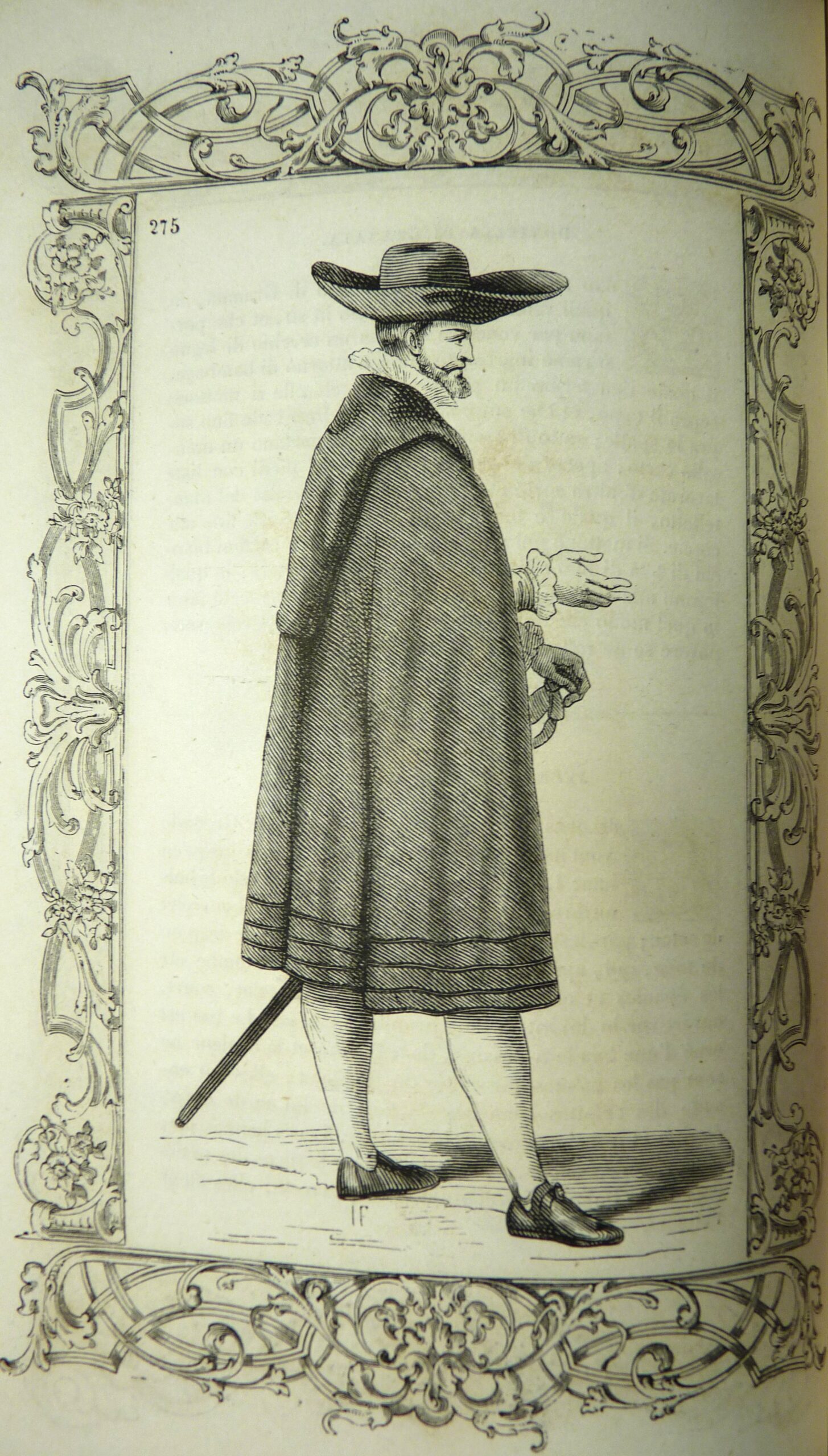
Pêro da Covilhã
Born around 1460 in the mountain town of Covilhã in Portugal’s Beira Interior, Pêro da Covilhã was a polyglot royal squire, undercover intelligence agent, diplomat, and overland explorer. Serving two monarchs—Dom Afonso V and Dom João II—he executed the most ambitious espionage mission of the fifteenth century: mapping the Indian Ocean spice network and locating the Christian realm of Prester John a full decade before Vasco da Gama set sail.
Castile and Court Service
As a boy of roughly nine or ten, Pêro was sent to Andalusia to serve in the household of the “Duke of Seville” (the house of Medina Sidonia), where he mastered Castilian and spoken Arabic. Returning to Portugal in 1475 at age fifteen on the eve of the War of the Castilian Succession, he entered the service of King Dom Afonso V as a moço de esporas (royal youth groom). Soon promoted to escudeiro (squire with horse and lance), he fought at the Battle of Toro (1476) at sixteen and accompanied the King to the court of France.
Barbary and the East
Following the death of King Afonso in 1481, his son and successor, King Dom João II, appointed Pêro a squire of the Royal Guard (escudeiro da Guarda Real) and dispatched him undercover into Castile to track exiled noble conspirators. Two delicate missions to Barbary followed: first to negotiate a treaty of peace and friendship with the Sultan of Tlemcen, and second to the Sultanate of Fez ostensibly to purchase purebred Berber horses for the young Duke Dom Manuel. Having proven his linguistic skill and resourcefulness, Pêro was chosen in May 1487—alongside Afonso de Paiva—for the King’s supreme covert mission to the East: Pêro was to trace the spice trade to its source in the Indies and chart the maritime routes thither; Afonso was to locate the legendary Prester John.
Aden and the Indies
The two agents traveled across Spain and the Mediterranean to Rhodes. Disguised as Muslim merchants they continue to Alexandria, Cairo, and the Red Sea before parting ways at Aden in 1488: Pêro sailed the monsoon to the Malabar Coast of India, the Persian Gulf, and down the East African coast to Sofala, while Afonso struck out for Ethiopia. Afonso never arrived at their agreed rendezvous in Cairo in late 1490, However, two secret royal couriers did: Rabbi Abraham of Beja and José Zapateiro of Lamego, They brought new orders from King João II: Pêro was to send his Indian Ocean intelligence home, escort the Rabbi to Hormuz, and find Prester John himself if this had not already been done.
Who Is Behind this Site and Why?
My name is Michael Henry Broderick, I write as M. H. Broderick, but everybody calls me Mike—and I like it that way. I’m the author of the epic Covilhã’s Secret Journal historical fiction series—find out all about it at Books. I talk about it on my author hub, mhbroderick.com. There, you can look me up under Author.
While the author hub deals with the fiction, this history hub deals with the facts. The novels in the series though lean on this site—not to explain Covilhã’s story, his world, or language: these aspects are made clear in context and refined in a brief appendix to each book. However, this history hub complements the series by expanding on the topics touched by the novels.
Thus, the purpose of this website is to present factual information on Pêro da Covilhã, the Portuguese expansion, as well as the cultures and technologies of the late fifteenth and early sixteenth centuries in the West and in the East. In this sense it functions as a gateway to and from the author site—and thus Pêro da Covilhã’s fictitious and verifiable world.
While writing the novels in the Covilhã’s Secret Journal series, I’ve gathered as much information as I could on Pêro da Covilhã’s life, his epic journey, the places he visited, and the things he accomplished. This led to a collection of of 2,000 books and maps in my private library.
And to jog my memory and learn more about the languages Pêro spoke, I noted down all the words, their meaning, and pronunciation. Also, to be sure I roughly understood what I was talking about, I wrote little essays on things and made a list of sources so that I could find them again. This led to detailed lists and tables—just click Reference in the menu or use the search icon.

The Year-of-Birth Debate
Because no baptismal record from fifteenth-century Covilhã survives, historians have traditionally split over the year of Pêro’s birth—ranging from c. 1450 (estimated by his nineteenth-century biographer, the Conde de Ficalho) to c. 1460 (favored by modern reference works and adopted for the Covilhã’s Secret Journal series). When weighed against sixteenth-century court customs and demographic realities, the primary evidence strongly favors the later date around 1458–1460:
Why Was Covilhã’s True Mission
Erased from History?
Considering the scale of Pêro da Covilhã’s accomplishments, it is astonishing how little the public knows of him. Beyond his early service as a soldier, diplomat, and undercover agent in Castile and North Africa, Covilhã traversed the Indian Ocean and reached India a full decade before Vasco da Gama. He was the first European we know of to sail down the Red Sea, along the East African coast to Sofala, and across the Arabian Sea to the Strait of Hormuz. He was also the first documented European to enter Mecca—more than ten years before the much-cited Bolognese traveler Ludovico di Varthema (c. 1470–1517), as the earlier Bavarian captive Johann Schiltberger (1394–1427) never actually claimed to have visited the holy city despite later assertions. Finally, he was the first European envoy in an official capacity to reach the court of Preste João (Prester John)—the Nəgusä Nägäst or Emperor of Ethiopia. Four historical factors explain why so little documentation of his life survives (explored in detail under Secrecy):
Fortunately, one contemporary Portuguese priest met Pêro da Covilhã face-to-face in the highlands of Abyssinia and recorded his story directly from his own lips.
The Account of Álvares
Pater Francisco Álvares accompanied the embassy of Rodrigo de Lima to the Preste João—as the Portuguese continued to call the Negus of Abyssinia. The mission arrived in 1520 and stayed until 1526. The relation of Father Álvares about the country is the holy grail of information on Pêro da Covilhã. Álvares was not only his contemporary, but met him in person at the Court of the King of Kings. Covilhã had accomplished all his missions for the Portuguese King and had become a highly valued advisor at the Abyssinian court, but was not permitted to leave the country.
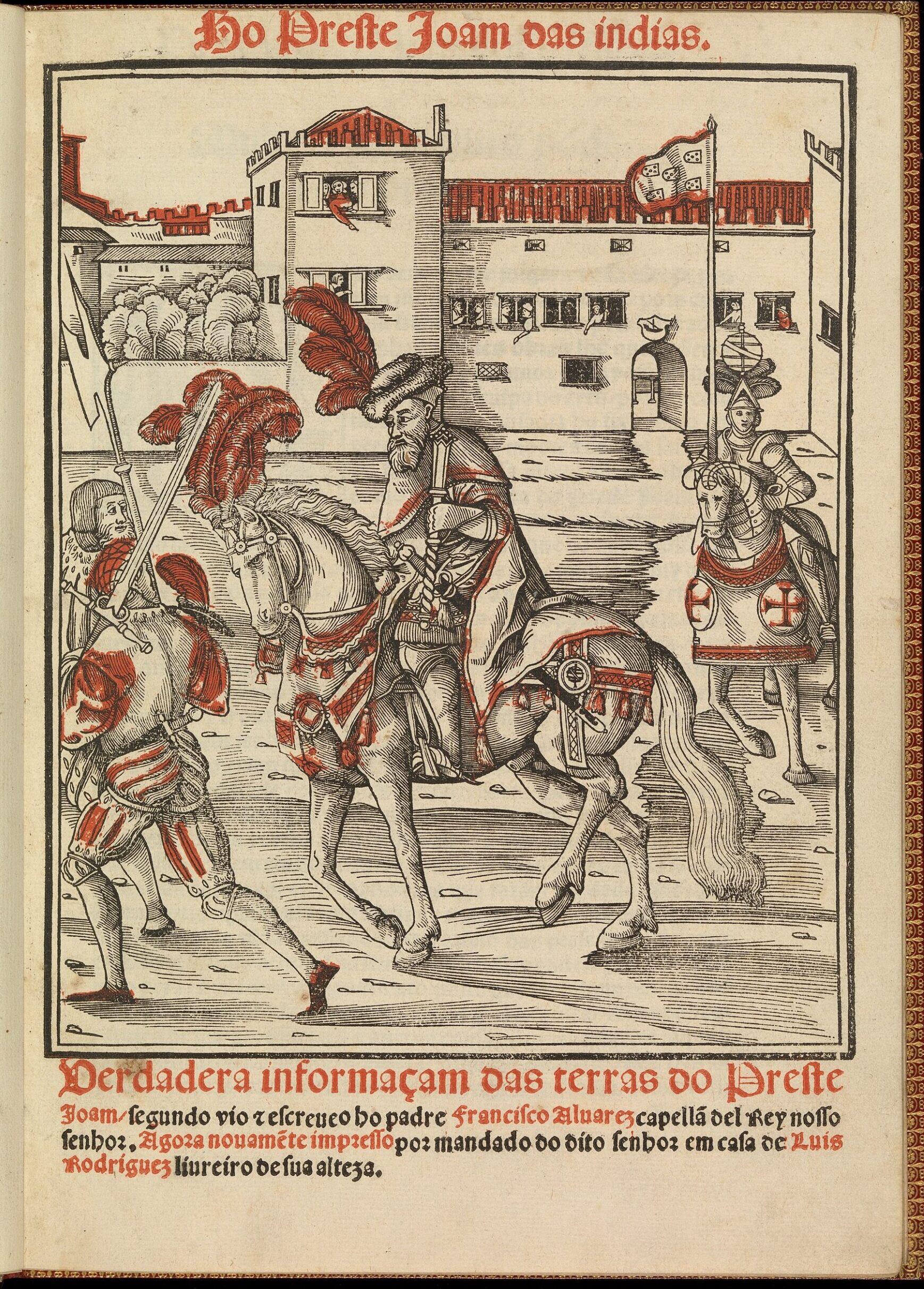
Title page of Father Francisco Álvares’ relation
Ho Preste Joam das Indias.
The approach of the Portuguese ambassador to the Abyssinian court probably didn’t quite look like that of the title-page picture. Emperor Dawit II, better known as Ləbnä Dəngəl, lived in a great tent encampment like the emperors before him. And there were no such buildings as depicted.
There are two excellent English translations of Father Francisco Álvares’ work:
Álvares mentions Pêro da Covilhã often throughout his book and devoted an entire chapter to him. Below is the complete verbatim text of this chapter from Lord Stanley’s translation (please note that I have not changed a single word or the spelling, but the division of the text into paragraphs is mine):
Chapter CIII:
How Pero de Covilham, Portuguese,
is in the country of the Prester, and how
he came there, and why he was sent.
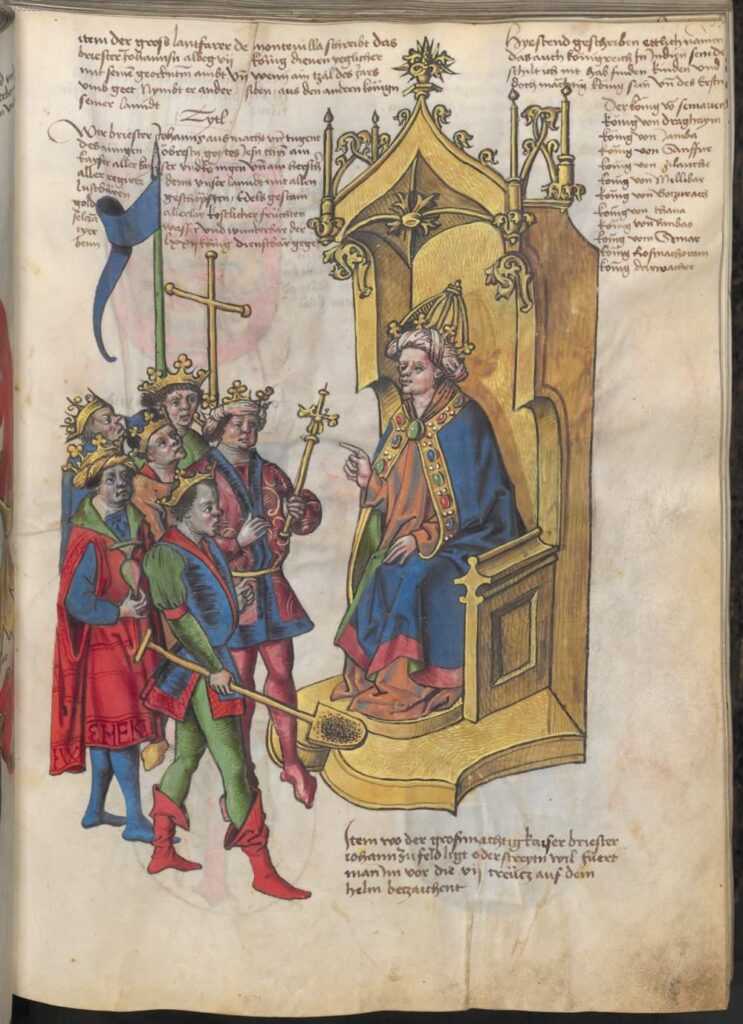
I have sometimes spoken of Pero de Covilham, a Portuguese, who is in this country, and have quoted him, and will not desist from quoting him, as he is an honourable person of merit and credit, and it is reasonable that it should be told how he came to this country, and I will relate the cause of it, and what he told me of himself. Firstly, I say that he is my spiritual son, and he told me in confession, and out of it, how thirty-three years had passed that he had not confessed, because he said in this country they do not keep the secret of confession, and he only went to the church and there confessed his sins to God.
Besides, he related to me the beginning of his life; first, that he was a native of the town of Covilham in the kingdoms of Portugal, and in his youth he had gone to Castile to live with Don Alfonso, Duke of Seville, and at the beginning of the wars between Portugal and Castile he had come with Juan de Guzman, brother of the said Duke of Seville, to Portugal. This Don Juan had given him to Don Afonzo, King of Portugal, as a groom, and he soon took him as his squire, and he served in that capacity in the said wars, and went with the king to France.
When king Don Afonzo died he remained with king Don Joan his son, whom he served as squire of the guard until the treasons, when the king sent him to go about Castile, because he could speak Castilian well, in order to learn who were the gentlemen who had gone there.
Read the rest of the entire chapter.
On his return from Castile, the King Don Joan sent him to Barbary to buy woollen cloths and to make peace with the King of Tremezen; and returning he was again sent to Barbary, to Muley Belagegi, he who sent the remains of the Infante Don Fernando. In this journey he carried goods of the King Don Manuel, who was then Duke, to buy horses for him, because the King Don Joan intended to give him an establishment, and one Pero Afonso, a veterinary, an inhabitant of Tomar, was going to inspect the horses.
On this arrival coming from Barbary, it was ordained that one Afonso de Payva, a native of Castel Branco, should come to these parts, and he waited for Pero de Covilham to come together. When he came, the King spoke to him in great secrecy, telling him that he expected a great service of him, because he had always found him a good and faithful servant, and fortunate in his acts and services; and this service was that he and another companion, who was named Afonso de Payva, should both go to discover and learn about Prester John, and where cinnamon is to be found, and the other spices which from those parts went to Venice through the countries of the Moors.
And that already he had sent on this journey a man of the house of Monterio, and a friar named frey Antonio, a native of Lisbon, and that they both had arrived at Jerusalem, and that they had returned thence, saying that it was not possible to go to those countries without knowing Arabic, and therefore he requested Pero de Covilham to accept this journey and to do this service with the said Afonso de Payva. To which Pero de Covilham answered, that he regretted that his capacity was not greater, so great was his desire to serve His Highness, and that he accepted the journey with ready willingness.
They were despatched from Santarem on the 7th of May of 1487; King Don Manuel, who was then Duke, was present, and gave them a map for navigating, taken from the map of the world, and it had been made by the Licentiate Calçadilha, who is Bishop of Viseu, and the doctor mestre Rodrigo, inhabitant of Pedras negras, and the doctor mestre Moyses, at that time a Jew, and this map was made in the house of Pero d’Alcaçova; and the King gave four hundred ducats for the expenses of both of them, which he gave out of the chest of the expenses of the garden of Almeirim, the King Don Manuel, then Duke, being present at all this.
The King Don Joan also gave him a letter of credence for all the countries and provinces in the world, so that in case he saw himself in danger or necessity, this letter of the King’s might succour him: and in the presence of the Duke he gave them his blessing. Of the said four hundred ducats they took a part for their expenses, and the rest they placed in the hands of Bartolomeu, a Florentine, for it to be given to them in Valencia.
Setting out, they travelled and arrived at Barcelona on the day of Corpus Domini: and they changed their route from Barcelona to Naples, and they arrived at Naples on St. John’s day, and their journey was given them by the sons of Cosmo de Medicis; and from there they passed to Rhodes; and he says that at this time there were not more than two Portuguese in Rhodes, one was named frey Gonzalo, and the other frey Fernando, and they lodged with these.
From here they passed to Alexandria in a ship of Bartolomeu de Paredes: and in order to pass as merchants, they bought much honey, and they arrived at Alexandria. Here both the companions fell ill of fevers; and all their honey was taken by the Naib of Alexandria, thinking that they were dying, and God gave them health, and they paid them at their pleasure. Here they bought other merchandise and went to Cairo.
Here they remained until they found some Moghreby Moors of Fez and Tremecem, who were going to Aden, and they went with them to Tor, and there they embarked and went to Suaquem, which is on the coast of Abyssinia; and thence they went to Aden, and because it was the time of the monsoon, the companions separated, and Afonso de Payva went to the country of Ethiopia, and Pero de Covilham to India, agreeing that at a certain time they should both meet in Cairo to come and give an account of what they had found to the King.
And Pero de Covilham departed thence and came to Cananor, and thence to Calicut, and from there he turned back to Goa, and went to Ormuz, and returned to Tor and Cairo in search of his companion, and he found that he was dead. Whilst he was about to set out on the way to Portugal, he had news that there were there two Portuguese Jews who were going about in search of him; and by great cleverness they heard about each other, and when they had met, they gave him letters from the King of Portugal.
These Jews were named, one, Rabbi Abraham, a native of Beja, the other, Josef, a native of Lamego, and he was a shoemaker. This shoemaker had been in Babilonia, and had heard news or information of the city of Ormuz, and had related it to King Don Joan, with which news, he said, the King had been much pleased. And Rabbi Abraham had sworn to the King that he would not return to Portugal without seeing Ormuz with his own eyes. When the letters had been given and read, their contents were, that if all the things for which they had come were seen, discovered, and learned, that they should return and welcome, and they should receive great favours: and if all were not found and discovered, they were to send word of what they had found, and to labour to learn the rest; and chiefly they were to go and see and learn about the great King Prester John, and to show the city of Ormuz to the Rabbi Abraham.
Besides the letters, these Jews made requisitions to Pero de Covilham that he should go and learn about Prester John, and show the city of Ormuz to Rabbi Abraham. Here he at once wrote by the shoemaker of Lamego, how he had discovered cinnamon and pepper in the city of Calicut, and that cloves came from beyond, but that all could be had there; and that he had been in the cities of Cananor, Calicut, and Goa, all on the coast, and to this they could navigate by their coast and the seas of Guinea, coming to make the coast of Sofala, to which he had also gone, or a great island which the Moors call the island of the moon; they say that it has three hundred leagues of coast, and that from each of these lands one can fetch the coast of Calicut.
Having sent this message to the King by the Jew of Lamego, Pero de Covilham went with the other Jew of Beja to Aden, and thence to Ormuz, and left him there, and returned thence and came to Jiddah and Mekkah and El Medina, where lies buried the Zancarron, and from thence to Mount Sinai. Having seen all well he again embarked at Tor and went as far as outside the strait to the city of Zeila, and thence travelled by land until he reached Prester John, who is very near to Zeila.
And he came to the Court, and gave his letters to the King Alexander, who then reigned, and he said that he received them with much pleasure and joy, and said that he would send him to his country with much honour. About this time he died, and his brother Nahum reigned, who also received him with much favour, and when he asked leave to go he would not give it. And Nahum died, and his son David reigned, who now reigns; and he says he also asked him for leave and he would not give it, saying that he had not come in his time, and his predecessors had given him lands and lordships to rule and enjoy, and that leave he could not give him, and so the matter remained.
This Pero de Covilham is a man who knows all the languages that can be spoken, both of Christians, Moors, and Gentiles, and who knows all the things for which he was sent; moreover he gives an account of them as if they were present before him.
The Research Documents
Practically all known monographs, relations, chronologies, and historical documents relevant to Pêro da Covilhã reside in my private library. The original manuscripts and the absolute rarest print editions, however, remain under lock and key in archives like the Portuguese national Torre do Tombo.