
Prester John
The Myth of Preste João
Preste João is what the Portuguese called the fabulous Prester John of the Indies. The Spanish called him Preste Juan, the French Prêtre Jean, and the Germans Presbyter Johannes or Priesterkönig Johannes. Throughout the Middle Ages and the early modern period, Western Christendom believed implicitly in the existence of this mighty Christian priest-emperor in the East—a ruler of realms where milk and honey flowed, where spices grew in abundance, and where riverbed pebbles were precious gems.
Such a powerful Christian monarch was the exact strategic ally King Dom João II of Portugal sought in his push to circumnavigate Africa and reach the Three Indias.1 With the aid of Preste João, Lisbon hoped to secure the spice trade of the Indian Ocean and outflank the Islamic powers controlling the Red Sea and Egypt.
It was for this reason that King Dom João II summoned Pêro da Covilhã and Afonso de Paiva to Santarém on May 7, 1487, tasking them with a dual covert mission: to trace the spice routes to their eastern emporiums and to locate the court of Preste João.
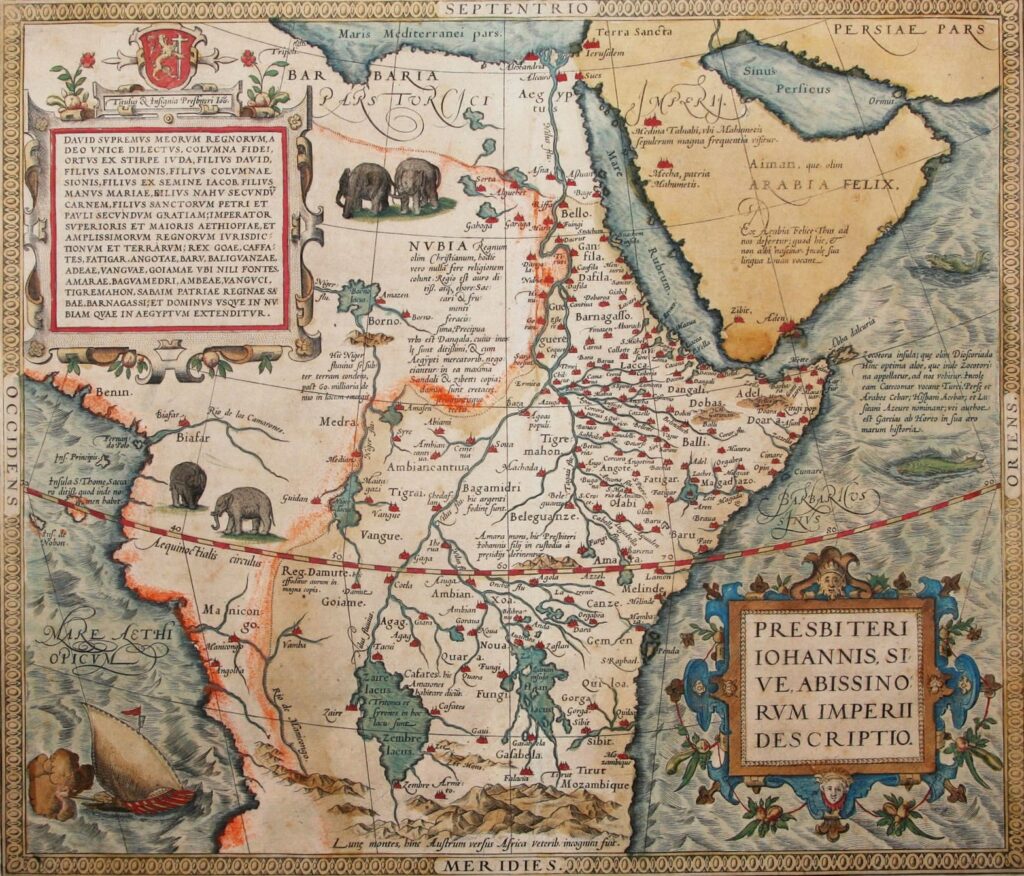
Presbiteri Johannis, sive, Abissinorum Imperii Descriptio (Description of the Empire of Prester John, or of the Abyssinians), engraved by Abraham Ortelius (1603 edition; first published in Antwerp, 1573).
Medieval “Fake News”
The “post-factual age” began much earlier than modern commentators assume. Indeed, if the term implies an era that followed some golden age of rigorous truth in politics, such a factual age never existed—certainly not where Prester John was concerned.
The very first historical report of Prester John was political disinformation, as Orientalist C. F. Beckingham demonstrated in his landmark 1966 inaugural lecture at the University of London:2
In short, a distant military battle was recounted to a serious historian (Otto) by a political envoy (Hugh), who wove a fictitious eastern priest-king into his report to persuade European monarchs to launch a new Crusade.
Sixteenth-century European woodcut of Prete Jan (Prester John) enthroned with a processional cross (reproduced in Albert Kammerer, La Mer Rouge, l’Abyssinie et l’Arabie depuis l’antiquité, Plate XCII).
The Presbyter Letter
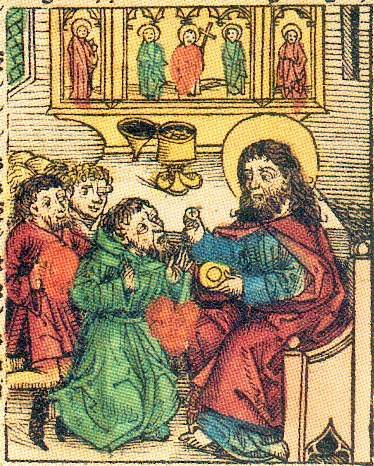
Late medieval European depiction of Prester John (Priester Johannes) bearing the dual insignia of priesthood and kingship, inspired by the twelfth-century Presbyter Letter.
Soon after Otto of Freising’s chronicle, a sensational document began circulating across Europe: a letter addressed to the Byzantine Emperor Manuel I Komnenos, purportedly written by Prester John himself. Its extravagant descriptions of eastern wealth and military might enjoyed a succès fou throughout late medieval Europe. Below is an excerpt from the Latin text edited by Friedrich Zarncke and translated by G. R. Crone:3
“Emmanuel, know and believe without hesitation that I, Prester John, am lord of lords and surpass in all riches which are under the heaven, in virtue and in power all the kings of the wide world. Seventy-two kings are tributary to us. I am a devout Christian and our magnificence dominates the three Indias. Several of these provinces are Christian, and have their own king. Our land flows with honey and abounds with milk. Through one of our provinces flows a river and in it are found emeralds, sapphires, amethysts, and many other precious gems. In another province of ours whole pepper grows.”
Here again, Beckingham’s 1966 lecture separates historical fact from centuries of uncritical commentary:2
“The letter is usually said to have begun to circulate in western Europe in or about 1165. This statement is often made more dogmatically than is justified by the very scanty evidence. It depends on a reference in the chronicle of Albéric of Trois Fontaines: ‘At this time Presbyter Johannes, the king of the Indians, sent his letters full of marvelous things to different kings of Christendom, but especially to Manuel, the Constantinopolitan emperor, and to Frederick, the emperor of the Romans.’
The latter is, of course, Frederick Barbarossa. This does not inspire confidence. In the manuscripts which Zarncke examined, numbering about eighty, the letter is addressed to Manuel, not to Frederick or to any other monarch…. Albéric himself is an historian of altogether inferior caliber compared with Otto of Freising…. All we can say, then, about the date of Prester John’s famous letter is that it cannot have been written before 1143, when Manuel came to the throne, and that it is most unlikely to have been written after the news of his death in 1180 had become generally known. Its authorship is still mysterious….
The phrase in Tribus Indiis is … the only real indication of where the empire [of Prester John] was supposed to be…. The Three Indias were Nearer or Lesser India, Further or Greater India, and Middle India.1 Middle India was, of course, Ethiopia. As is well known, this identification is explicitly made by Marco Polo…. Prester John, when at last he was found, or, it would be better to say, when an embodiment of the legend had been agreed upon, was a disappointment. Far from aiding the Portuguese to capture Mecca, as Albuquerque had supposed he might, it was they who had gone to his help against the Muslim invader Ahmad Grañ.”4
Ogané: The West African Clue
Shortly before dispatching Covilhã and Paiva in 1487, King Dom João II received intriguing intelligence from West Africa concerning a “most powerful monarch … called Ogané, [who] was held in as great veneration as is the Supreme Pontiff with us,” as the chronicler João de Barros records in Book III, Chapter 4 of his first Década da Ásia.5
This report reached Lisbon through João Afonso de Aveiro, who had sailed south after Diogo Cão’s voyages along the African coast and explored the Kingdom of Benin around 1485–1486, gathering intelligence from the local court:
“The king of Benin, on ascending the throne, sends ambassadors to [Ogané] with rich gifts to announce that … he has succeeded to the kingdom of Benin, and to request confirmation. To signify his assent … Ogané … sends … a cross … to be worn round the neck, a holy and religious emblem similar to that worn by the Commendadores of the Order of Saint John…. All the time this ambassador is at the court of Ogané, he never sees the prince, but only the curtains of silk behind which he sits, for he is regarded as sacred.”
To King Dom João II and his cosmographers, these rituals—especially the monarch’s concealment behind silk curtains and the bestowal of a cross—matched accounts heard from Abyssinian priests in Jerusalem regarding their Emperor, whom Europeans identified with Prester John. Because Ogané was reported to reside 250 leagues east of Benin, royal geographers placed his realm in the African interior between the Red Sea and the Praso promontory on the East African coast. In 1486, Dom João resolved to launch a grand strategic pincer movement—sending ships by sea around Africa and undercover agents by land via Egypt—to establish contact with Prester John and secure the sea route to the spices of India.
The Quest for Preste João
Combining the West African reports of Ogané with intelligence gathered from Ethiopian pilgrims in Jerusalem, King Dom João II made the quest for Preste João a cornerstone of Portuguese state policy. Earlier contacts already pointed toward East Africa: in 1452, during the reign of his father, King Dom Afonso V, a document in the royal chancery recorded expenses for one Jorge, described as an “ambassador of Preste João.”6
In his 1898 monograph on Pêro da Covilhã, the Conde de Ficalho placed Dom João’s pursuit of this “glorious enterprise” into cartographic perspective, highlighting the decisive influence of the famous mappa mundi created in Venice by the Camaldolese monk Fra Mauro and delivered to Portugal in 1459:7
“Such were the current notions of the subject in the days of the Infante Dom Henrique [Prince Henry]; and such, with minor changes, were preserved when King Dom João II took the pursuit of his uncle’s glorious enterprise in his firm hands. In the last years of the life of the Infante, Fra Mauro had built in his Camaldolese convent of San Michele di Murano, by order and at the expense of [King] Dom Afonso V [the father of Dom João], the famous mappa mundi, sent to Portugal in the year 1459 or 1460. On this map, the [West] African coast to Cape Verde was already very exactly delineated, having taken the result of the recent discoveries of the Portuguese into account. The coast on the other side [East Africa] was rounded by a hypothetical curve, connecting with the eastern part known from the travels of Arabs. In the interior of Africa, towards the eastern side, the Preste João [Prester John] was located in Abássia [Abyssinia], with the following inscription: ‘Qui il Presto Janne fá residentia principale.’ Abássia, which however was drawn very far off to the south and extended to the coasts of the Austral Sea, gave the impression on the whole mappa that with continued navigation and discovery, one should be able to reach points on the coast belonging to the Prester’s lands.”
Described by the Italian historical geographer Roberto Almagià as “the greatest memorial of medieval cartography,”8 Fra Mauro’s world map contains several detailed inscriptions regarding Prester John and Abyssinia (translated below by Jeremy Scott in Piero Falchetta’s critical edition):9
Legend 57: “Above the Kingdom of Abássia there is a very savage and idolatrous people…. These men are very strong and of great stature and they pay tribute to Prester John, King of Abássia, and two thousand of these men serve him to his needs, etc.”
Legend 66: “Here Prester John has his main residence.”
Legend 77: “It is said that Prester John has more than 120 kingdoms under his dominion, in which there are more than 60 different languages. And of all this number—that is, the 120—it is said that 72 are powerful seigneuries, and that the others are not of much account.”
Legend 83: “This king of Abássia, called Prester John, has many kingdoms under his dominion; and his enormous power is held in esteem because of the numbers of his people, who are almost infinite. And when this lord travels with his armies, he has with him one million men, who go naked into battle, except that many of them wear crocodile skin in place of armor.”
Armed with these converging clues, King Dom João II put his geopolitical strategy into motion on October 10, 1486, appointing Bartolomeu Dias to lead a maritime expedition around the southern tip of Africa while simultaneously dispatching two envoys overland toward Jerusalem. As Professor Beckingham observed in a 1979 lecture at the University of Manchester, the failure of that first overland attempt led directly to Pêro da Covilhã’s appointment:10
“It was at this juncture that King João decided on a double attempt to settle the problem by sending two missions, one by land and the other by sea. The latter is much better known. It was commanded by Bartolomeu Dias and it succeeded in discovering the Cape of Good Hope. The overland expedition was an almost farcical failure. Two men, Frei António de Lisboa and one Pêro de Montarroio, went as far as Jerusalem, but because they did not know Arabic, did not dare to accompany the monks they met there, by whom is no doubt meant the Ethiopian pilgrims, whom they had hoped to join on their journey home. The excuse, as is given in Barros, seems lame indeed. It is not impossible to acquire the rudiments of Arabic and one would have expected them to do so. It seems to me more likely that the Ethiopians may have travelled as Muslims and were perhaps afraid that the two Portuguese would not be willing or able to pass as Muslims, or that they themselves thought so. In any event they returned to Portugal and the king then dispatched Pêro da Covilhã and Afonso de Paiva.”
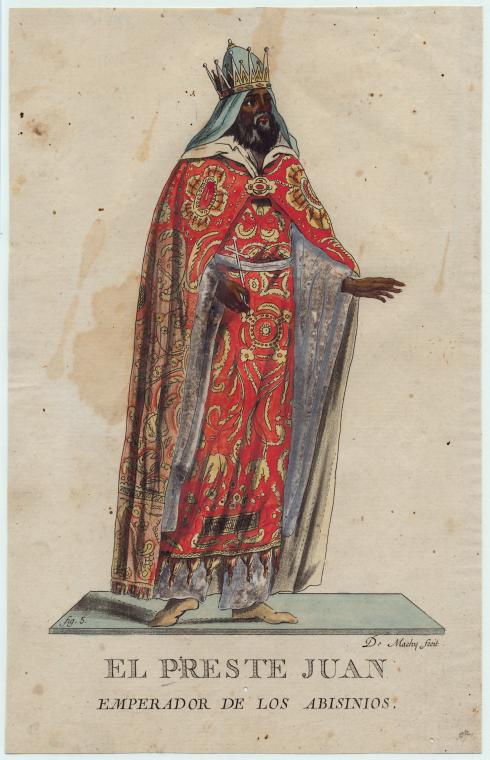
El Preste Juan, Emperador de los Abisinios: hand-colored engraving after Cesare Vecellio’s Habiti antichi et moderni di tutto il mondo (Venice, 1598; Firmin-Didot edition, Paris, 1859–1860).
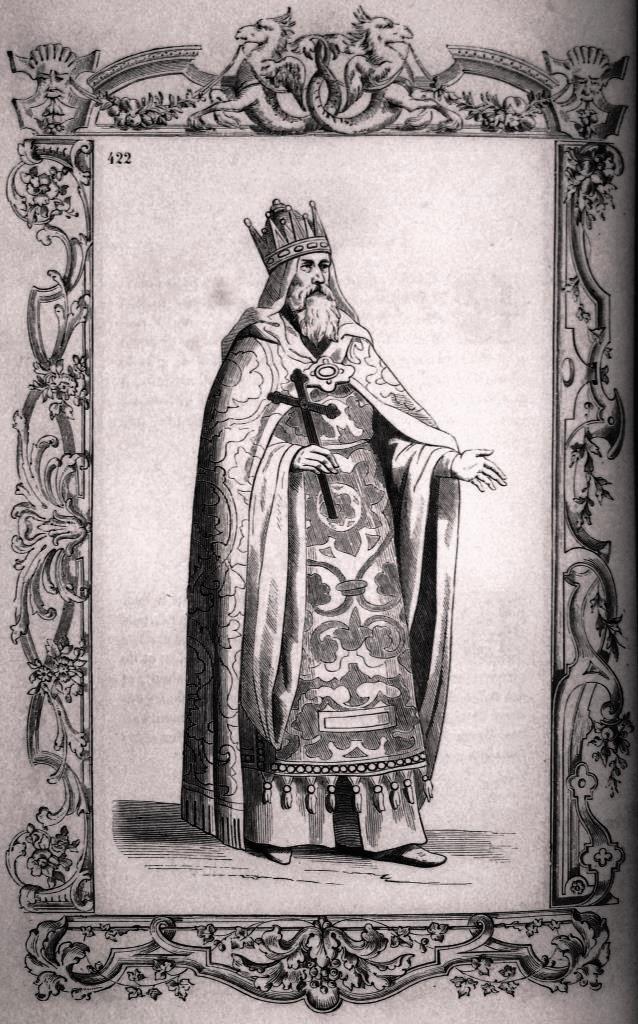
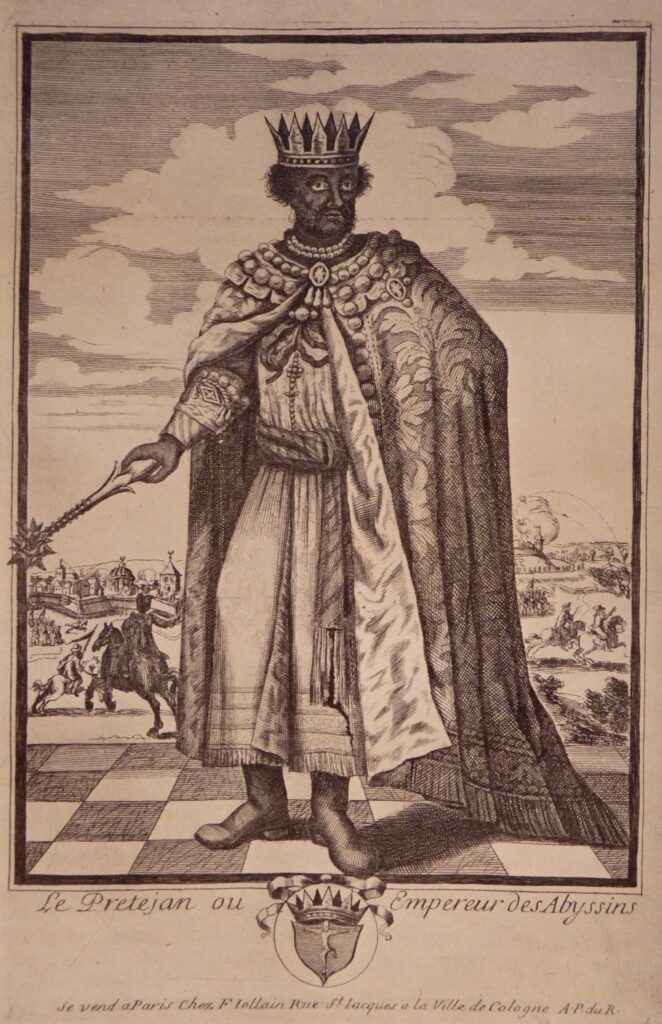
Costume du Prêtre-Jean (Habito del Prete Gianni), wood engraving by Ambroise Firmin-Didot from Cesare Vecellio, Costumes anciens et modernes (Paris, 1859–1860, after the 1590 and 1598 Venice editions).
Notes & Sources
- Until the early modern era, European geographers divided the East into the Three Indias: Greater India (India Maior, a Portuguese form attested since the fifteenth century), denoting the southern Indian subcontinent or the region from the Malabar Coast to the Malay Archipelago; Lesser India (India Minor), spanning the territory from Sind to Malabar; and Middle India (India Tertia), comprising the East African littoral including Ethiopia (Abyssinia). Because medieval writers applied these terms inconsistently—often calling Ethiopia “Lesser India” or simply “the Indias,” as in Francisco Álvares’s Ho Preste Joam das Indias (1540)—modern commentators have occasionally mistaken authentic medieval accounts for fabrications.
- C. F. Beckingham, The Achievements of Prester John: An Inaugural Lecture Delivered on 17 May 1966 (London: School of Oriental and African Studies, University of London, 1966).
- Friedrich Zarncke, Der Priester Johannes (Leipzig, 1879; facsimile edition in 2 vols., Hildesheim, 1980); English translation abridged from G. R. Crone (ed. and trans.), The Voyages of Cadamosto and Other Documents on Western Africa in the Second Half of the Fifteenth Century (London: Hakluyt Society, 1937).
- Imām Aḥmad is the title of the third volume in the Covilhã’s Secret Journal series. Imām Aḥmad ibn Ibrāhīm al-Ghāzī (nicknamed Grañ, “the Left-Handed”) of the Sultanate of Adal led an invasion that conquered most of Christian Abyssinia during the Ethiopian–Adal War (1529–1543).
- João de Barros, Décadas da Ásia: Primeira Década, Book III, Chapter 4 (Lisbon, 1552).
- Elaine Sanceau, Portugal in Quest of Prester John (London, 1943), p. 11. Sanceau uncovered this record in the royal Chancelaria of King Dom Afonso V; it refers to an envoy named Jorge, whom no contemporary or subsequent chronicler ever mentioned again.
- Conde de Ficalho (Francisco Manuel de Melo Breyner), Viagens de Pero da Covilhan (Lisbon, 1898), pp. 30–31.
- Roberto Almagià, Monumenta cartographica Vaticana, Vol. 1 (Vatican City: Biblioteca Apostolica Vaticana, 1944), p. 32.
- Piero Falchetta, Fra Mauro’s World Map: With a Commentary and Translations of the Inscriptions, trans. Jeremy Scott, Terrarum Orbis 5 (Turnhout: Brepols / Venice: Biblioteca Nazionale Marciana, 2006), pp. 193, 195, 197, 199.
- C. F. Beckingham, “The Quest for Prester John,” lecture delivered at the University of Manchester (1979), in C. F. Beckingham and Bernard Hamilton (eds.), Prester John, the Mongols, and the Ten Lost Tribes (Aldershot: Variorum, 1996), p. 305.