
Ships
Suits in Playing Cards.
In the 15th century, the English term for a suit in playing cards was “suit” itself, while in Italian, the term was “seme” or “semi” (plural). These terms referred to the distinct categories of cards within a deck, such as cups, coins, swords, and batons (or clubs).
Elaboration:
English:
While the modern English term “suit” was already in use in the 15th century, it’s worth noting that the specific symbols and their names (like “spades,” “hearts,” “diamonds,” and “clubs”) were still evolving and varied across different regions.
Italian:
The Italian term “seme” (or “semi”) specifically refers to the distinct categories within the deck. These suits were typically:
Coppe (Cups)
Denari (Coins or Money)
Spade (Swords)
Bastoni (Staves or Clubs)
Evolution of Suits:
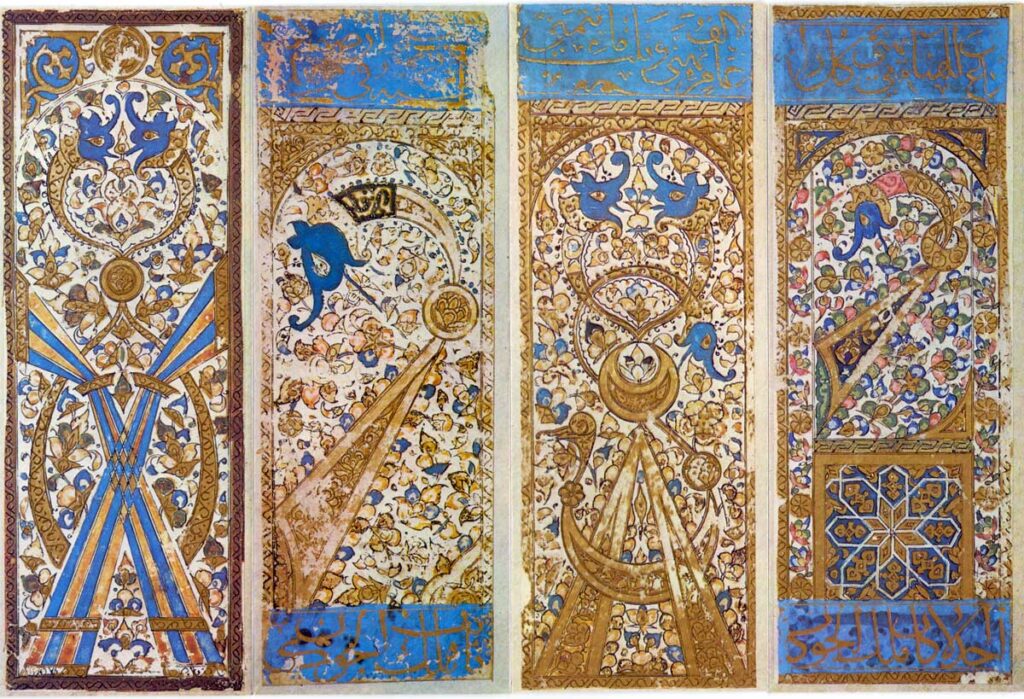
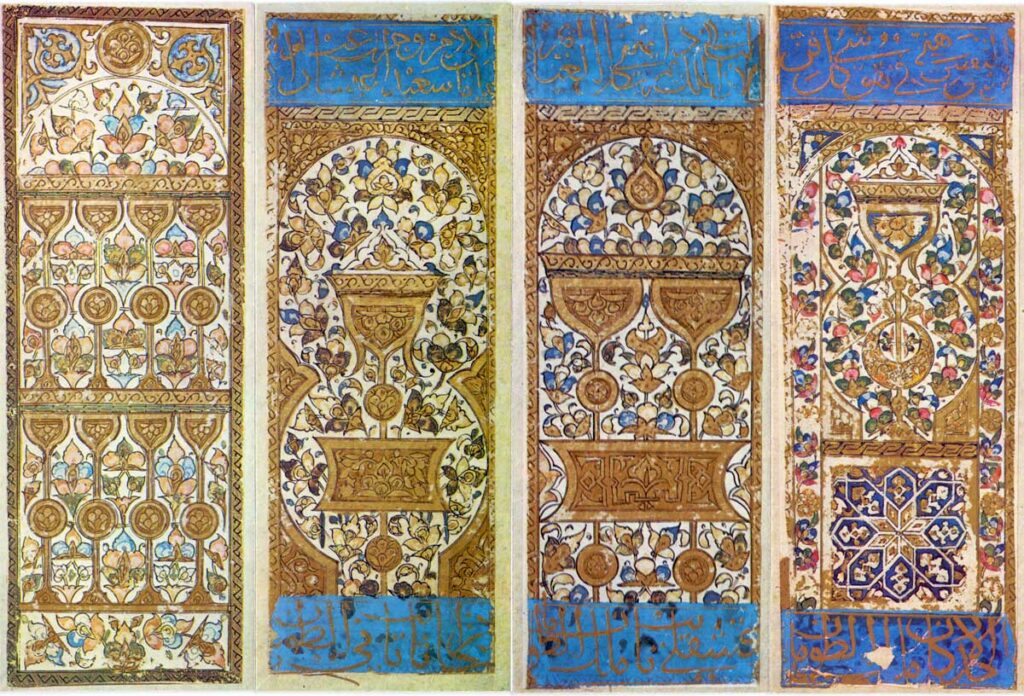
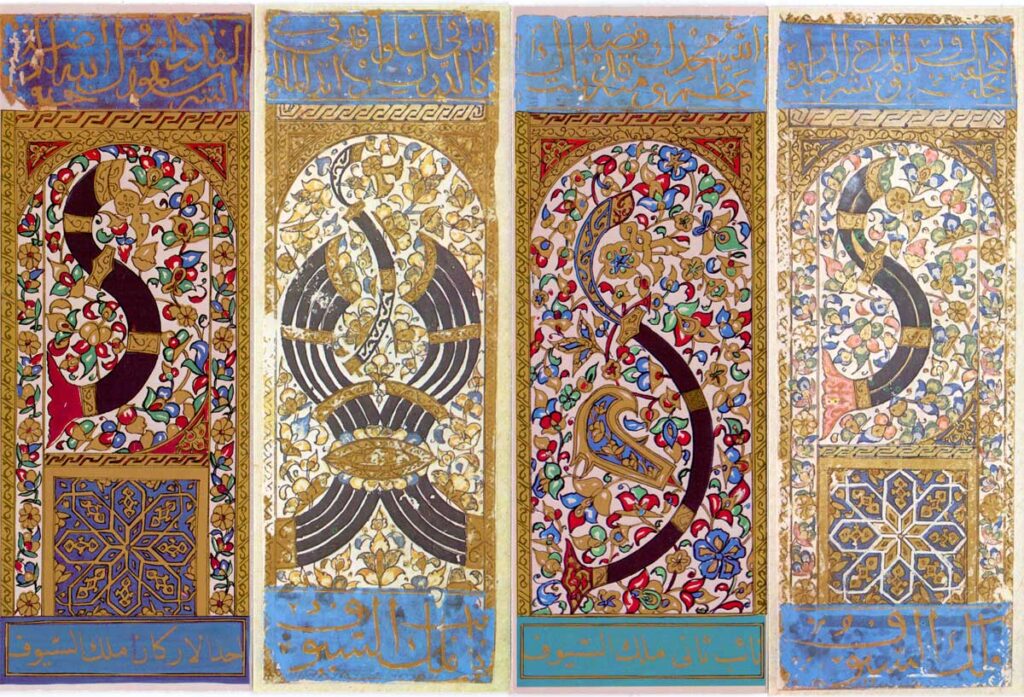
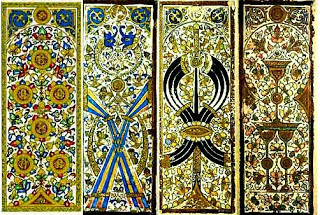
The four suits in Italian-suited cards (cups, coins, swords, and batons) were influenced by earlier Mamluk playing cards, which featured goblets, coins, swords, and polo sticks. When these suits were adopted in Europe, the polo sticks were often transformed into batons.
French Influence:
The French suits (hearts, diamonds, clubs, and spades) became standardized in the mid-15th century and eventually gained widespread popularity, influencing the suits used in English-speaking regions.
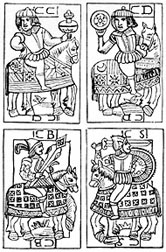
Early Portuguese playing cards.
Mamluk Playing Cards
Behind every successful voyage and clandestine mission commissioned by King Dom João II stood the Junta dos Matemáticos—a specialized royal scientific committee established in Lisbon around 1484 to overhaul Portuguese navigation.
As Portuguese caravels pushed south across the Equator, navigators encountered a profound crisis: the North Star (Polaris), which had guided mariners for centuries, sank below the northern horizon and disappeared from view. Without it, dead reckoning alone spelled disaster on the open ocean.
King João II charged the Junta—comprising Bishop Diogo Ortiz de Vilhegas (“Calçadilha”), Doctor Rodrigo, and the Jewish astronomer Mestre Moisés, alongside the exiled Spanish astronomer Abraham Zacuto—with developing practical methods to calculate latitude using the midday sun.
The Junta successfully adapted medieval Arabic and Hebrew astronomical tables into simplified solar declination manuals and standardized navigational charts (cartas de marear). When Pêro da Covilhã and Afonso de Paiva stood before King João II in Santarém on May 7, 1487, it was this Junta that provided them with their state-secret navigational chart and instructions—bridging the gap between scholarly Islamic cosmography and Portuguese oceanic empire.
Painéis de São Vicente de Fora (The Panels of St. Vincent), attributed to royal painter Nuno Gonçalves, c. 1470–1480 (Museu Nacional de Arte Antiga, Lisbon).
Painted during Pêro da Covilhã’s youth, this monumental six-panel polyptych offers a vivid window into the fifteenth-century Portuguese court under King Dom Afonso V and the young Prince Dom João II. Alongside royalty, knights, monks, mariners, and fishermen stand royal chroniclers, astronomers, and Jewish court scholars—including a figure in the right-hand Panel of the Relic holding an open Hebrew book—illustrating the exact intellectual milieu from which the Junta dos Matemáticos emerged.
Frankisch Playing Cards
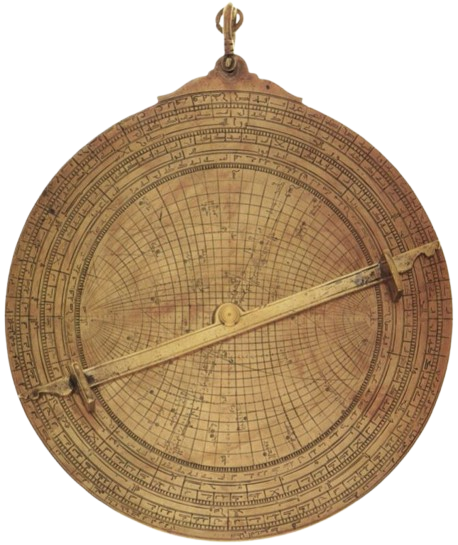
Chief among the scientific instruments of the medieval Mediterranean and Islamic world was the astrolabe (Arabic asṭurlāb, from the Greek astrolabos, “star-taker”). Functioning simultaneously as an observational altitude-finder and an analog celestial computer, a brass astrolabe enabled a skilled user to measure the altitude of the sun or fixed stars above the horizon, tell the hour of day or night, determine terrestrial latitude, cast astronomical tables, and—in the Islamic world—calculate the times of daily prayer (ṣalāt) and the true compass bearing toward Mecca (qibla).
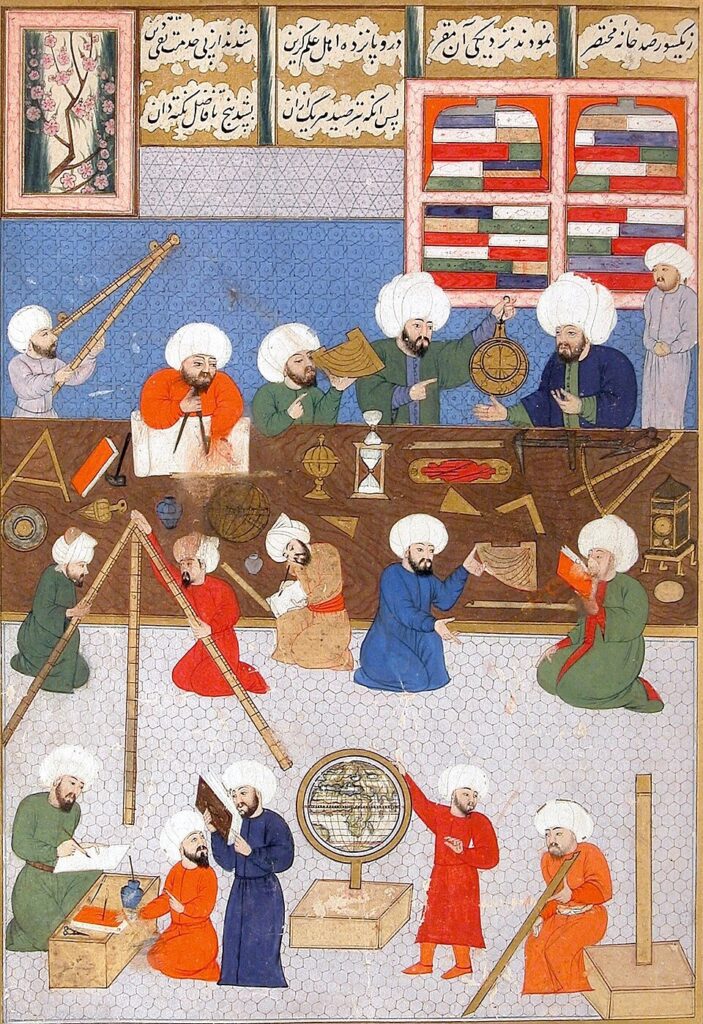
Astronomers working with planispheric astrolabes, quadrants, an armillary sphere, and a terrestrial globe at Taqī al-Dīn’s observatory in Constantinople (c. 1577). Miniature from the Shāhnāma-yi Shāhinshāhī of ‘Alā’ ad-Dīn Manṣūr Shīrāzī (1581), Istanbul University Library (MS F. 1404, fol. 57a).
The Early Iberian Playing Cards
From Chatto’s Origin and History of Playing Cards.
In writing of the deck from which the four cavaliers (jacks) here reproduced were taken, William Andrew Chatto notes: “Some of the specimens of Portuguese cards given in the “Jeux de Cartes Tarots et de Cartes Numérales’ have very much the appearance of having been originally suggested by, if not copied from, an Oriental type; more especially in the suits of Danari and Bastoni, —Money and Clubs. In those cards the circular figure, generally understood as representing Danari, or Money, is certainly much more like the Chakra, or quoit of Vichnou [Vishnu], as seen in Hindostanee drawings, than a piece of coin; while on the top of the Club there is a diamond proper, which is another of the attributes of the same deity.” Also worthy of note are the Rosicrucian and Masonic emblems appearing on various mediaeval decks. As the secrets of these organizations were often concealed in cryptic engravings, it is very probable that the enigmatic diagrams upon various decks of cards were used both to conceal and to perpetuate the political and philosophical arcana of these orders. The frontispiece of Mr. Chatto’s book shows a knave of hearts bearing a shield emblazoned with a crowned Rosicrucian rose.
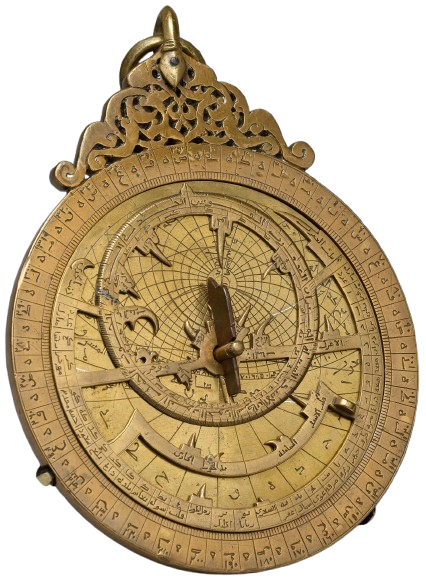
Planispheric astrolabe crafted and signed by the Rasulid prince ‘Umar ibn Yūsuf (later Sultan al-Ashraf ‘Umar II of Yemen), dated 690 AH / 1291 CE. Brass inlaid with silver. The Metropolitan Museum of Art, New York (91.1.535a–h).
The Portuguese Cards
To overcome this limitation, Andalusian and Maghrebi instrument makers combined the classic planispheric astrolabe on the front with a universal projection on the back known in Latin Europe as the Saphea Azarchelis (aṣ-Ṣafīḥa az-Zarqāliyya). Devised in eleventh-century Toledo and Córdoba by the renowned astronomer Abū Isḥāq Ibrāhīm az-Zarqālī (known to the Christians of Castile and Portugal as Azarquiel), the Saphea projected the celestial sphere stereographically from the equinoctial points rather than the pole—creating a single, universal grid that functioned at any latitude on Earth.
It is just such an instrument that Pêro obtained in the Sultanate of Tlemcen in the first novel, Terra Barbaria, of the Covilhã’s Secret Journal series.
The Spanish Cards
The fifteenth-century Maghrebi brass instrument illustrated here (19.4 cm in diameter) exemplifies the tools circulating between Andalusia, Fez, Tlemcen, and Cairo during Covilhã’s lifetime:
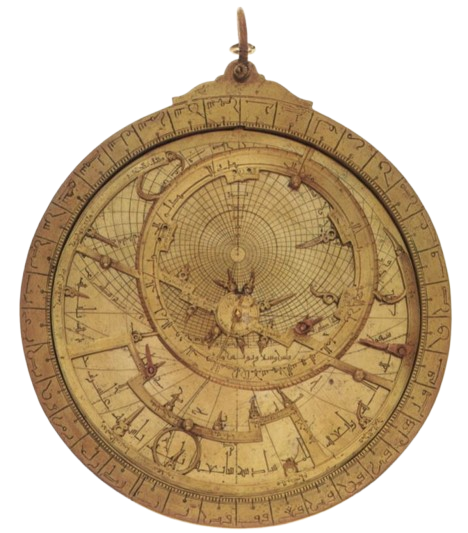
Obverse of a 15th-century Maghrebi brass astrolabe (Ø 19.4 cm), showing the pierced star-map (rete) with thirty star pointers, the zodiacal ecliptic ring, and the underlying latitude plate. Formerly Time Museum Collection (Inv. No. 1935; after A. J. Turner, 1985).
Reverse of the same instrument, engraved at its center with the universal projection of az-Zarqālī (Saphea Azarchelis) marking thirty-six stars, encircled by an eccentric zodiacal calendar bearing Western month names and outer altitude and shadow scales (after A. J. Turner, 1985).
Other Playing Cards
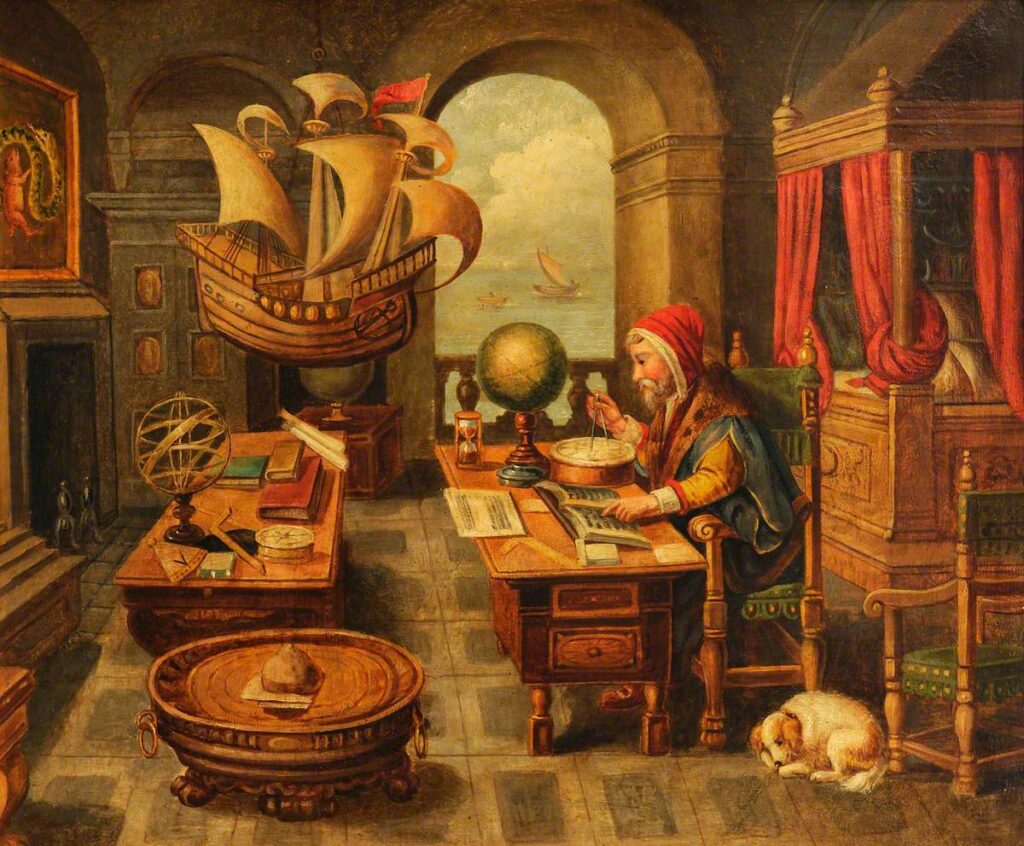
Lapis Polaris, Magnes (The Lodestone & Magnetic Compass), engraved by Philips Galle after Jan van der Straet (Stradanus) for the Nova Reperta series (Antwerp, c. 1590). A cosmographer works at his table with a magnetic compass, lodestone, dividers, and a brass astrolabe beneath a suspended ship’s model, while ocean-going caravels and carracks sail across the horizon.
Italian Cards
German Cards
While the complex planispheric astrolabe and the universal Saphea remained the domain of astronomers and royal cosmographers, practical travelers, pilots, and sea captains relied on a rugged trio of instruments to survive the open ocean:
Read Next: Chess →
Bla bla bla – talk about the Ships….
Bla bla bla – talk about the Ships….
Read Next: Instruments →