
Chess
Across the fifteenth-century Mediterranean, no pastime bridged the divide between Christian and Islamic courts more completely than chess. Originating in sixth-century India as chaturanga (“four divisions of the army”) and refined in Sasanian Persia and the Abbasid Caliphate as shatranj, the game entered Europe through Moorish Spain and Sicily. By Pêro da Covilhã’s lifetime, a traveler could sit down across a sixty-four-square board in Lisbon, Seville, Tlemcen, Cairo, or Calicut and speak a common strategic language—even as a radical Iberian rule change at the end of the fifteenth century transformed the sluggish medieval game into the lightning-fast contest of the modern Queen.
From Chaturanga to Shatranj
Long before it became a European parlor game of swift, devastating attacks, chess began its journey as chaturanga in ancient India, representing the four divisions of the military: infantry, cavalry, elephants, and chariots. Transmitted through Sasanian Persia into the Islamic world, the game was embraced as shatranj by caliphs, scholars, and poets.
During the Abbasid Caliphate, the great patron of science and philosophy **Al-Mamun** (c. 786–833)—son of Harun al-Rashid and founder of Baghdad’s legendary *Bayt al-Hikmah* (House of Wisdom)—captured the paradoxical complexity of the board with a famous wry observation:
“It is astonishing that I can govern the world from the Indus in the east to al-Andalus in the west, yet cannot master 32 chess pieces on a board four cubits square.”
In medieval Islamic and Christian courts alike, shatranj was a slow, deliberate tactical exercise. The pieces moved by leaping rather than gliding, and the central councilor adjacent to the king—the Persian firzan (vizier)—was a weak piece known in Latin Europe as the fers, restricted to moving a single square diagonally.
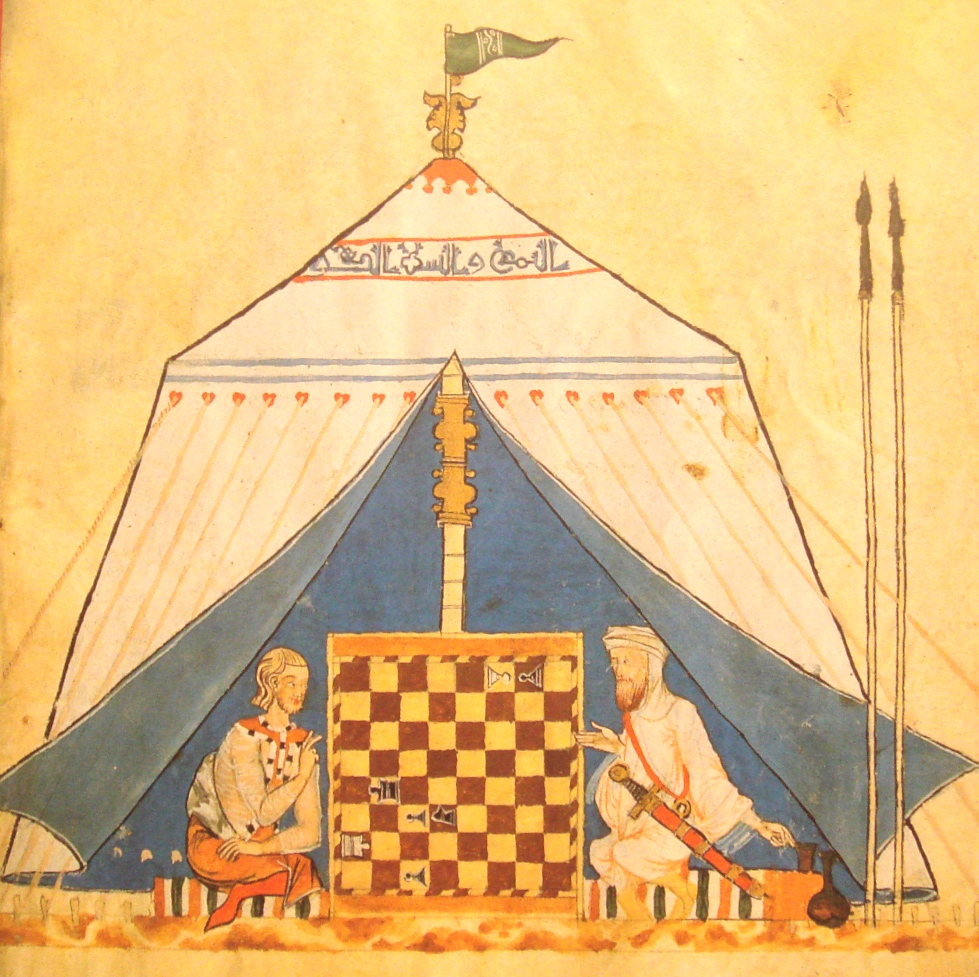
A Christian knight and a Muslim dignitary playing chess inside a campaign tent. Illumination from Alfonso X’s Libro de acedrex, dados e tablas (Seville, 1283, fol. 64r), Real Biblioteca del Monasterio de El Escorial.
Noble players and attendants seated around a medieval board. Miniature from Alfonso X’s Libro de acedrex dados e tablas (Seville, 1283), Real Biblioteca del Monasterio de El Escorial.
A la Dama o al Viejo?
In the first novel, Terra Barbaria, of the Covilhã’s Secret Journal series, the protagonist Pêro da Covilhã and his mentor, Dom Ruy de Pina, meet quietly in royal offices to dissect court politics and covert intelligence. Foregoing formal greetings, Pêro invariably asks in Castilian, “A la dama o al viejo?” And Dom Ruy always replies, “Dama.” With the board already set—its pieces perfectly aligned—they play a la dama: the daring, newly reformed game of chess.
Around the turn of the sixteenth century, European chess underwent a radical revolution that permanently divorced the modern game from its medieval parent. While medieval chess was characterized by sluggish, leaping moves (such as the early double-step leap of the *fers*), the new game introduced gliding movements across ranks, files, and diagonals. Only the knight and the act of castling retained their ancient leaping character.
The most dramatic manifestation of this transformation was the empowerment of the weak vizier (*fers*) into the terrifyingly mobile Queen. Italians dubbed the new game scacchi alla rabiosa (“mad chess”) or scacchi de la dama, Spaniards axedrez de la dama, and French échés de la dame enragée. Merging the straight-line range of the rook with the diagonal sweep of the bishop (formerly the *alfin* or elephant), the new Queen mirrored the formidable political authority wielded by reigning monarchs like Queen Isabella I of Castile—transforming chess from a stately medieval simulation into a ruthless tactical battleground.
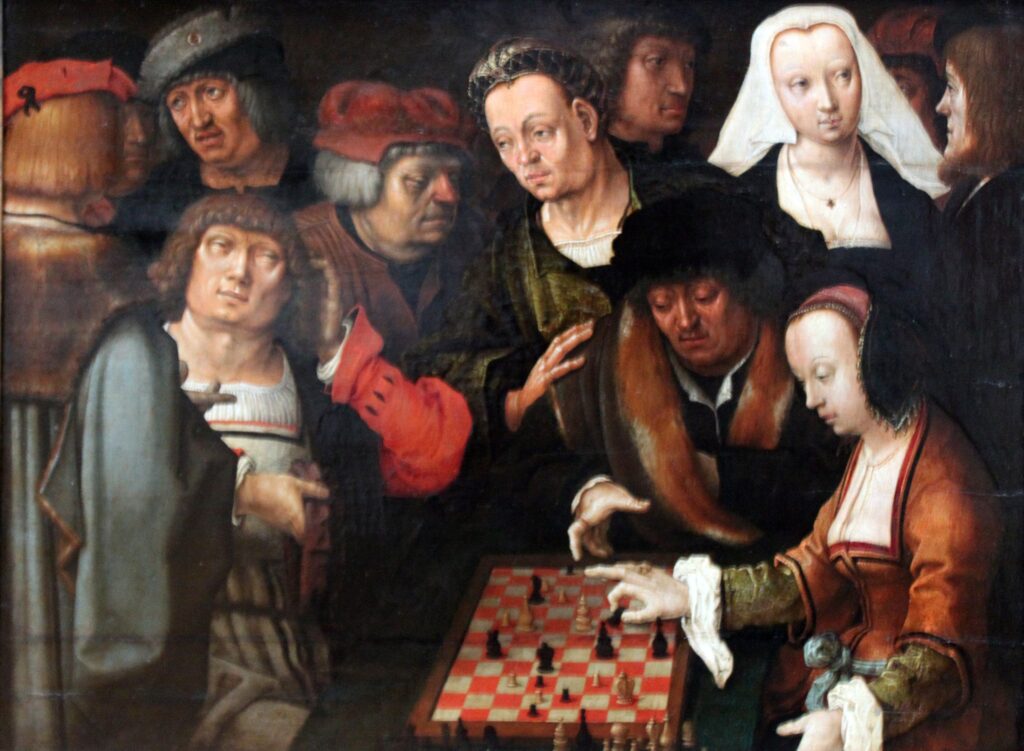
The Chess Players, oil painting by Lucas van Leiden (c. 1508), capturing early sixteenth-century play as the modern rules of chess took hold across Europe (Staatliche Museen zu Berlin).
Chess, Courtly Love, and the Alhambra
In medieval Iberia, chess was much more than a pastime; it functioned as an erotic metaphor for courtly love, chivalric capture, and geopolitical conquest. As scholar Daniel E. Oushy and other historians have demonstrated, medieval Spanish art frequently deployed chess to mirror the tensions of the Reconquest (711–1492)—equating the hero’s victory over a rival or captor at the board with the liberation of a damsel in distress.
This rich symbolic tradition is immortalized in two monumental Spanish monuments:
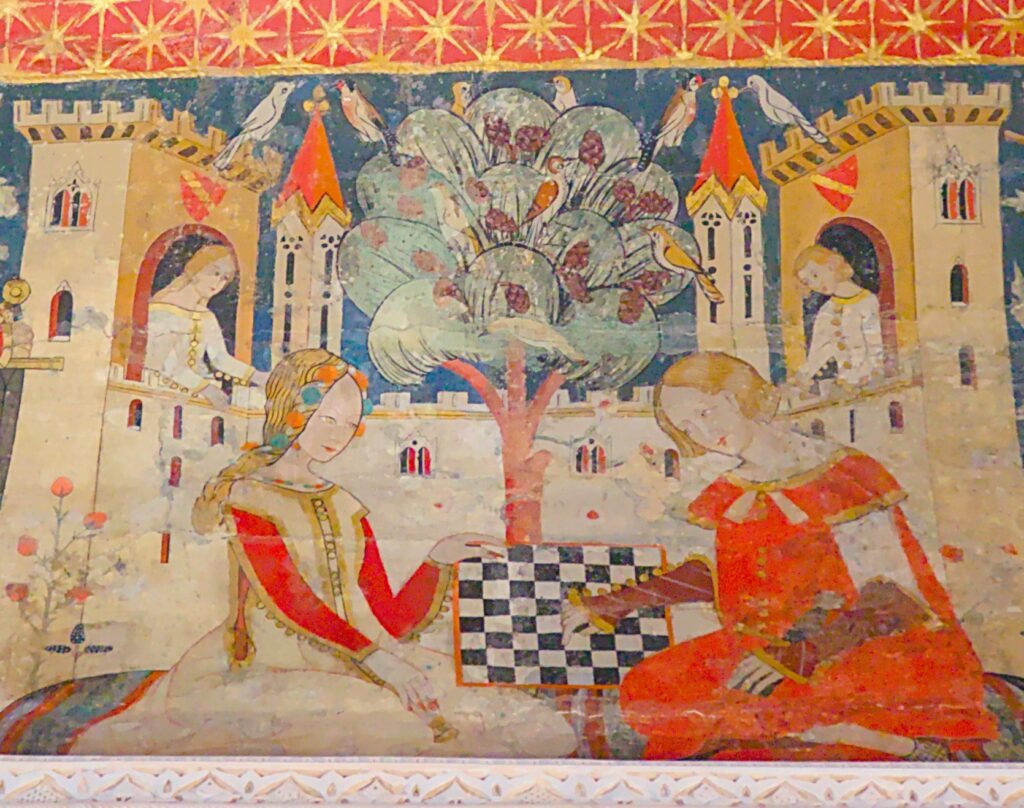
Detail of the fourteenth-century painted leather cupola in the Sala de los Reyes (Hall of Kings) of the Alhambra Palace, Granada, depicting a courtly chess match.