
Playing Cards
The early history of cards in Western Europe was related to the invasion of
North Africa, Spain and Sicily by Islamic forces during the Mamluk
Sultanate of Egypt which ended in 1517. This coincided with the Nasrid
Kingdom of Granada in Andalusia (13th – 15th century), the last Islamic
stronghold in the Iberian Peninsula. Spain () was the point of contact with
the Arab world, via the Strait of Gibraltar (http://www.wopc.co.uk/gibraltar
/index), where the cultural, military and commercial interactions occurred. The game of cards became established in most West European countries by c.1375, and was being banned by the authorities shortly afterwards which suggests their rapid popularity. See: Early References (http://www.wopc.co.uk/history/earlyrefs).
In the Muslim world of the Near East, and in India, where card playing was a pastime of the high born, hand painted cards, usually the products of court workshops, were the norm. In Europe, on the other hand, with the development of paper manufacturing and the invention of printing, cards were produced for a mass market and all classes were able to play cards.
Printed cards were common but hand painted cards were much rarer.
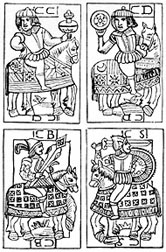
Early Portuguese playing cards.
Mamluk Playing Cards
The cards shown below are from a XV or early XVI century Mamluk pack, handdrawn and handpainted, probably belonging to a wealthy or illustrious owner. They are a beautiful example of the important and often overlooked cultural, technical and artistic influence which Islam has bestowed upon the
Western world, evident in the many artistic, architectural and archæological treasures displaying their characteristic geometric construction. In this case we are looking at the ancestor of our humble playing card. The underlying design is very simple but the surface has been ornamented. The border of some cards is in the shape of a horseshoe arch as seen in Islamic doorways, windows, friezes and gravestone decorations. The suits are coins, cups, swords and polo-sticks and there are 14 cards per suit: the numbers 1 to 10 plus 4 court cards, the King, the Lieutenant, the Second Lieutenant and the Assistant. The ranks of the court cards are given in the blue inscription areas at the bottom of the cards. In European packs the court cards were of course represented pictorially.
See also: Moorish playing Cards (http://www.wopc.co.uk/spain/moorish/index) Early References
(http://www.wopc.co.uk/history/earlyrefs). Download article about Early Introduction of Playing Cards into Europe
(http://www.wopc.co.uk/files/moorish.pdf). (400Kb PDF)
The calligraphic texts along the tops of the cards consist of rhyming aphorisms which are often very enchanting, sometimes strange, but always interesting: “With the sword of happiness I shall redeem a beloved who will afterwards take my life“ – “O thou who hast possessions, remain happy and thou shalt have a pleasant life.” – “Let it come to me, because acquired good is durable; it rejoices me with all its utility” – “Pleasures for the soul and agreeable things, in my colours there are all kinds” – “Look how wonderful my game is and my dress extraordinarily beautiful” – “I am as a garden, the like of which will never exist” – “O my heart, for thee the good news that rejoices” – “Rejoice in the happiness that returns, as a bird that sings its joy”.
“As for the present that rejoices, thy heart will soon open up“ – “I will, as pearls on a string, be lifted in the hands of kings” – “May God give thee prosperity; then thou will already have achieved thy aim” – “Rejoice for thy lasting happiness” – “Rejoice in the pleasant things and the success of the objects” – “I am as a flower, a string of pearls is my soil?” – “The alif rejoices and fulfils your wishes” – “Whosoever will call me to his happiness, he will only see joyful looks”.
Add text here.
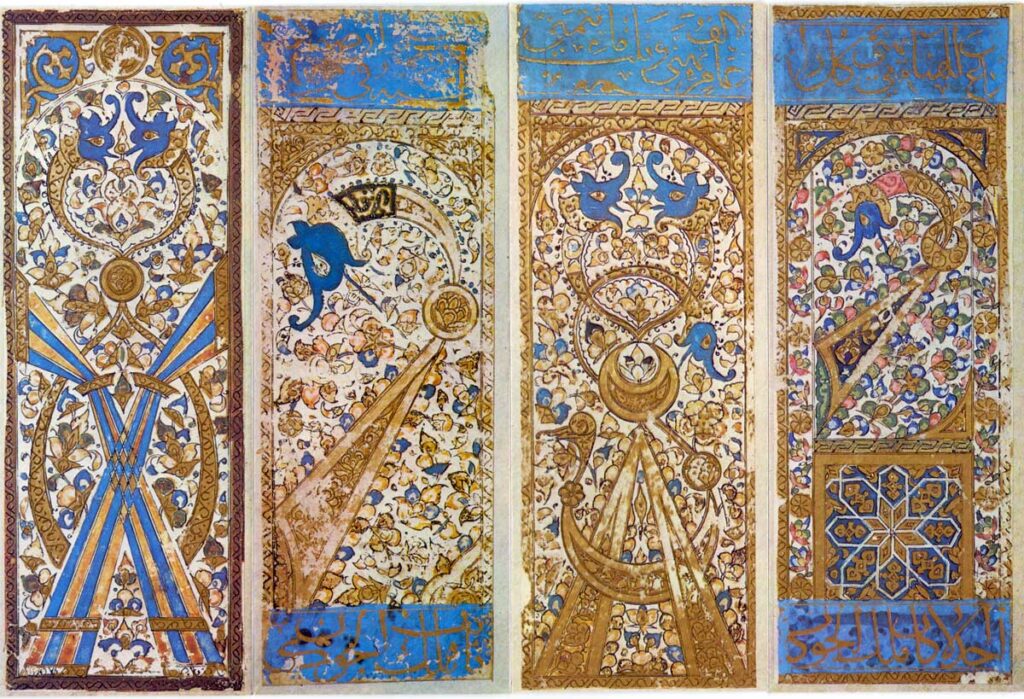
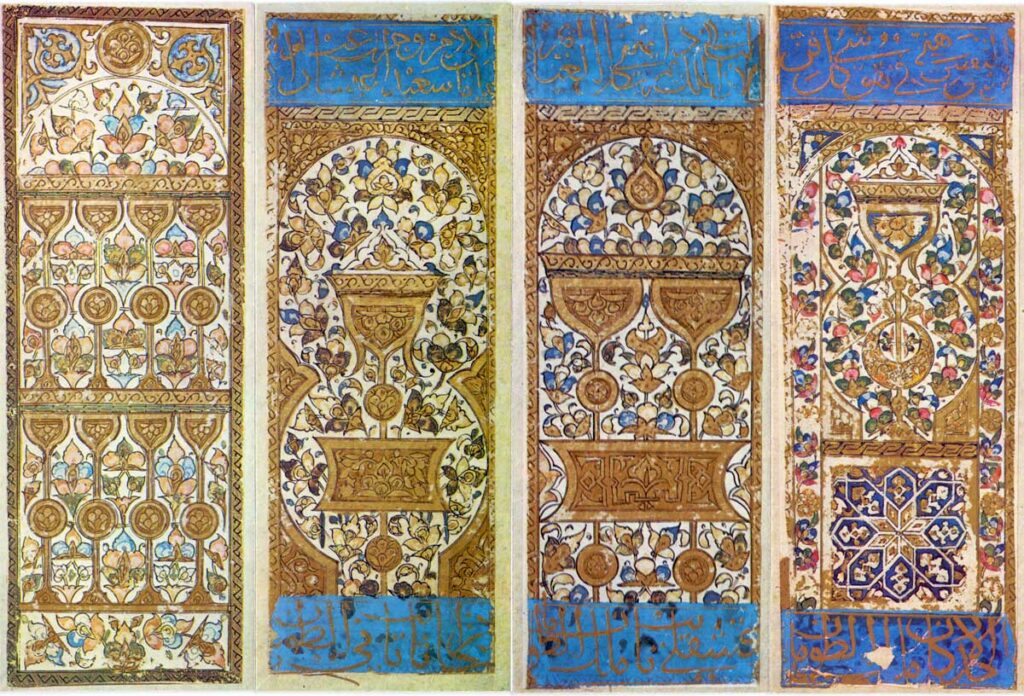
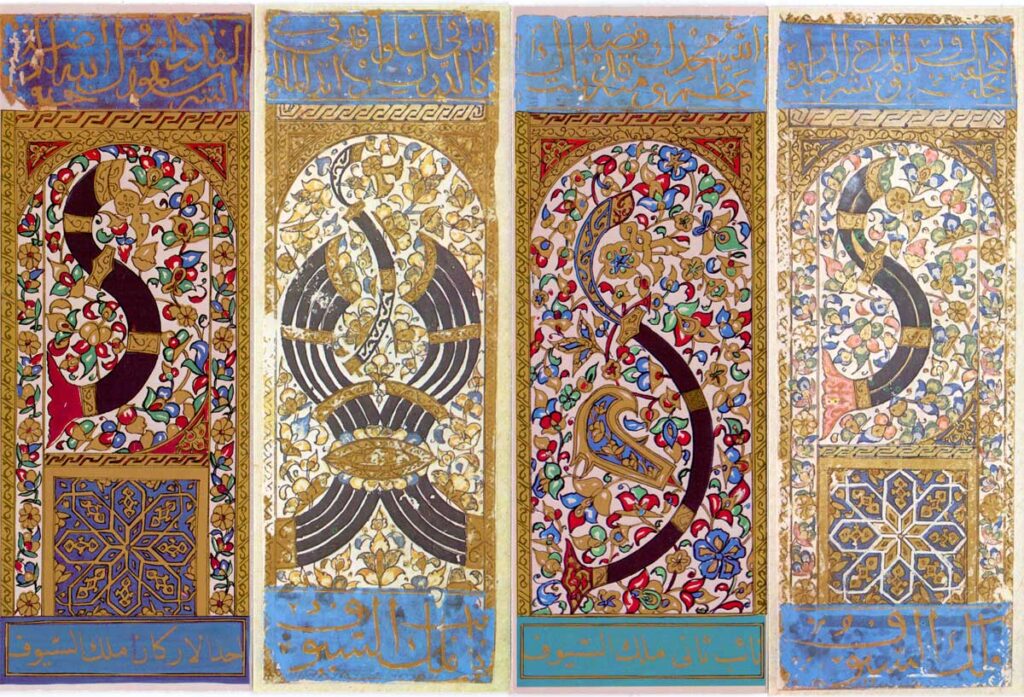
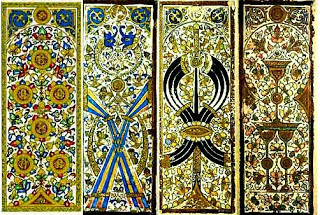
Above: hand-drawn and hand-painted Mamluk Playing Cards, XV or early XVI century. The original pack of cards is in the Topkapu Museum in Istanbul and measures 252 x 95 mms, which makes them rather large to hold in one’s hand. The pack of cards in the Topkapu Museum is incomplete and consists of 47 cards, divided into 4 suits, with 14 cards per suit, so that the complete pack would have contained 56 cards. The cards illustrated here are from a reconstructed
facsimile edition published by Aurelia Books, Brussels and Louvain, 1972. The boxed set also contains a booklet produced by Jan Bauwens which contains the Arabic inscriptions on the cards translated by Prof. Tangi of the University of Istanbul.
Add text here.
Frankisch Playing Cards
Chief among the scientific instruments of the medieval Mediterranean and Islamic world was the astrolabe (Arabic asṭurlāb, from the Greek astrolabos, “star-taker”). Functioning simultaneously as an observational altitude-finder and an analog celestial computer, a brass astrolabe enabled a skilled user to measure the altitude of the sun or fixed stars above the horizon, tell the hour of day or night, determine terrestrial latitude, cast astronomical tables, and—in the Islamic world—calculate the times of daily prayer (ṣalāt) and the true compass bearing toward Mecca (qibla).
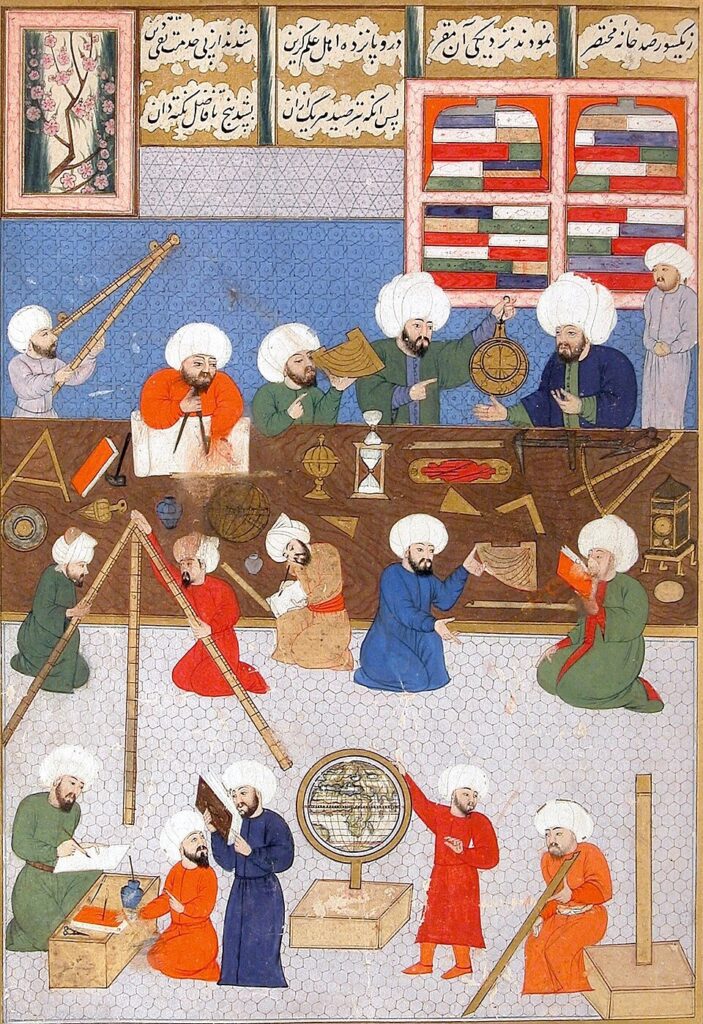
Astronomers working with planispheric astrolabes, quadrants, an armillary sphere, and a terrestrial globe at Taqī al-Dīn’s observatory in Constantinople (c. 1577). Miniature from the Shāhnāma-yi Shāhinshāhī of ‘Alā’ ad-Dīn Manṣūr Shīrāzī (1581), Istanbul University Library (MS F. 1404, fol. 57a).
The Early Iberian Playing Cards
From Chatto’s Origin and History of Playing Cards.
In writing of the deck from which the four cavaliers (jacks) here reproduced were taken, William Andrew Chatto notes: “Some of the specimens of Portuguese cards given in the “Jeux de Cartes Tarots et de Cartes Numérales’ have very much the appearance of having been originally suggested by, if not copied from, an Oriental type; more especially in the suits of Danari and Bastoni, —Money and Clubs. In those cards the circular figure, generally understood as representing Danari, or Money, is certainly much more like the Chakra, or quoit of Vichnou [Vishnu], as seen in Hindostanee drawings, than a piece of coin; while on the top of the Club there is a diamond proper, which is another of the attributes of the same deity.” Also worthy of note are the Rosicrucian and Masonic emblems appearing on various mediaeval decks. As the secrets of these organizations were often concealed in cryptic engravings, it is very probable that the enigmatic diagrams upon various decks of cards were used both to conceal and to perpetuate the political and philosophical arcana of these orders. The frontispiece of Mr. Chatto’s book shows a knave of hearts bearing a shield emblazoned with a crowned Rosicrucian rose.
Latin Suited Cards
[From IPS site: ]
Four suits:
Swords, batons, cups and coins. Each suit has three picture cards, generally a king, a knight on horseback and a jack or maid. Numeral cards run from 1 (ace) to 7 or 9 or occasionally 10.
Games played with Latin suited cards
The four latin suits are swords, batons, cups and coins. In each suit there are normally three picture cards – a king, a horseman and a jack or maid – and some numeral cards. Cards with latin suits are commonly used in Spain and in parts of Italy, North Africa and South America, and are also found in several other places. There latin suits cards in common use can be divided into two main types: Spanish suited and Italian suited.
Spanish and Italian playing cards.
The Spanish Suited Cards
In the Spanish suited type, the batons are knobly clubs or cudgels and the swords and batons are drawn separately on the pip cards.
Two other rarer types are generally recognised:
- The Portuguese type, in which the numeral cards have straight intersecting swords, and knobly intersecting batons, and the aces sometimes have pictures of dragons.
- The archaic type, in which the numeral cards have slightly curved non-intersecting swords.
The terms Italian, Spanish and Portuguese can be somewhat misleading.
- The Spanish type of cards are used not only in Spain but also in many parts of Italy, in northern Africa, in parts of the west coast of France and in Latin America.
- The Italian type is used in north-east Italy, and is also found in Croatia and in the Trappola cards that were used in central Europe until the mid twentieth century. This style of suits also accurs in the Tarot cards used in northern Italy and Switzerland.
- Latin cards are no longer used in Portugal, which has gone over entirely to French suits. Descenents of the Portuguese style survive tenuously in the cards of some oriental countries, such as Japan, which had contact with Portuguese traders in the past.
It is probable that the earliest European cards, brought to Italy and Spain from the Islamic worls in the late fourteenth century, had latin suits. The batons may originally have been polo sticks.
The main places where various types of latin cards are now used are as follows (please follow the links to the country pages for details of the games played in each place).
Spanish suited cards
In Spain, these cards are in general use. They are normally sold as a 48 card pack, with numerals 1 to 9 and court cards labelled 10, 11 and 12, though many games use only 40 cards, omitting the 8 and 9.
A 48 card Spanish style pack is also used in western France for the game of Aluette.
In the parts of Italy a 40 card pack in the Spanish style is used for the usual Italian card games such as Briscola and Scopa. These cards are sometimes called Italo-Spanish; different designs of this pack are associated with Naples, Sardinia, Sicily, Piacenza and Romagna.
The 40 card Spanish pack is in use in several north African countries.
The 40 card Spanish pack is found in many Latin American countries, including Argentina, Venezuela, Bolivia and Peru.
A 112 card Spanish pack is used in the Philippines for Cuajo.
Italian suited cards
The Italian style of cards are found mostly in north-east Italy. There are distinct patterns based in Venice, Trieste, Bergamo and Trento. Usually they come as 40 card packs with nuerals 1 to 7 and three picture cards in each suit, but they are also made as 52 card packs with numerals 1 to 10 for certain regional Italian games.
Italian suited Tarot packs have the usual four Italian suits plus a special series of trump cards. These are described on a separate page.
Trappola packs have 36 cards: ace, king, knight, jack, 10, 9, 8, 7, 2 in each suit. It is clear from the style of the cards as well as the history of the game that they originated somewhere near Venice, but this game spread northwards to central Europe – especially Germany, Austria and the Czech lands, and the Italian suited cards travelled with it. Trappola cards ceased to be produced in the mid twentieth century, though related games survive tenuously using substitute packs.
Oriental cards based on Portuguese designs.
Several types of these cards are or were used in Japan and Korea. The designs have evolved to such an extent that they are barely recognisable. The standard reference on the history and development of these cards is the book “The Dragons of Portugal”, by Sylvia Mann and Virginia Wayland (Sandford, Farnham, Surrey, UK, 1973).
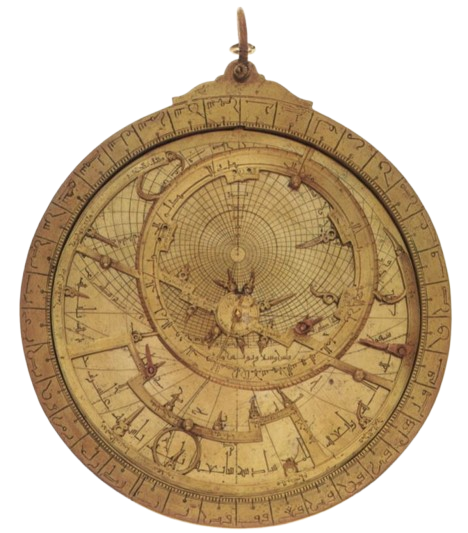
Obverse of a 15th-century Maghrebi brass astrolabe (Ø 19.4 cm), showing the pierced star-map (rete) with thirty star pointers, the zodiacal ecliptic ring, and the underlying latitude plate. Formerly Time Museum Collection (Inv. No. 1935; after A. J. Turner, 1985).
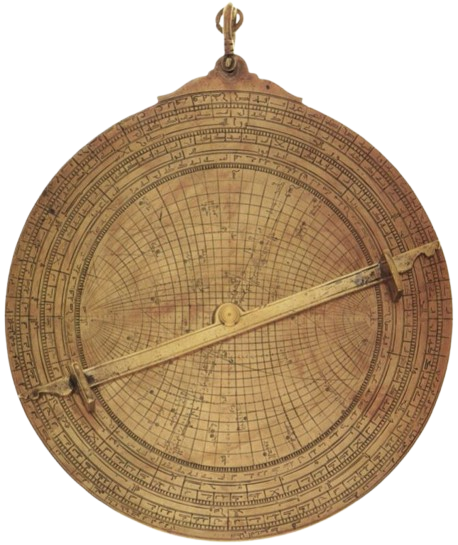
Reverse of the same instrument, engraved at its center with the universal projection of az-Zarqālī (Saphea Azarchelis) marking thirty-six stars, encircled by an eccentric zodiacal calendar bearing Western month names and outer altitude and shadow scales (after A. J. Turner, 1985).
The Portuguese Cards
Add text.
I
The Spanish Cards
Add text..
Obverse of a 15th-century Maghrebi brass astrolabe (Ø 19.4 cm), showing the pierced star-map (rete) with thirty star pointers, the zodiacal ecliptic ring, and the underlying latitude plate. Formerly Time Museum Collection (Inv. No. 1935; after A. J. Turner, 1985).
Reverse of the same instrument, engraved at its center with the universal projection of az-Zarqālī (Saphea Azarchelis) marking thirty-six stars, encircled by an eccentric zodiacal calendar bearing Western month names and outer altitude and shadow scales (after A. J. Turner, 1985).
Other Playing Cards
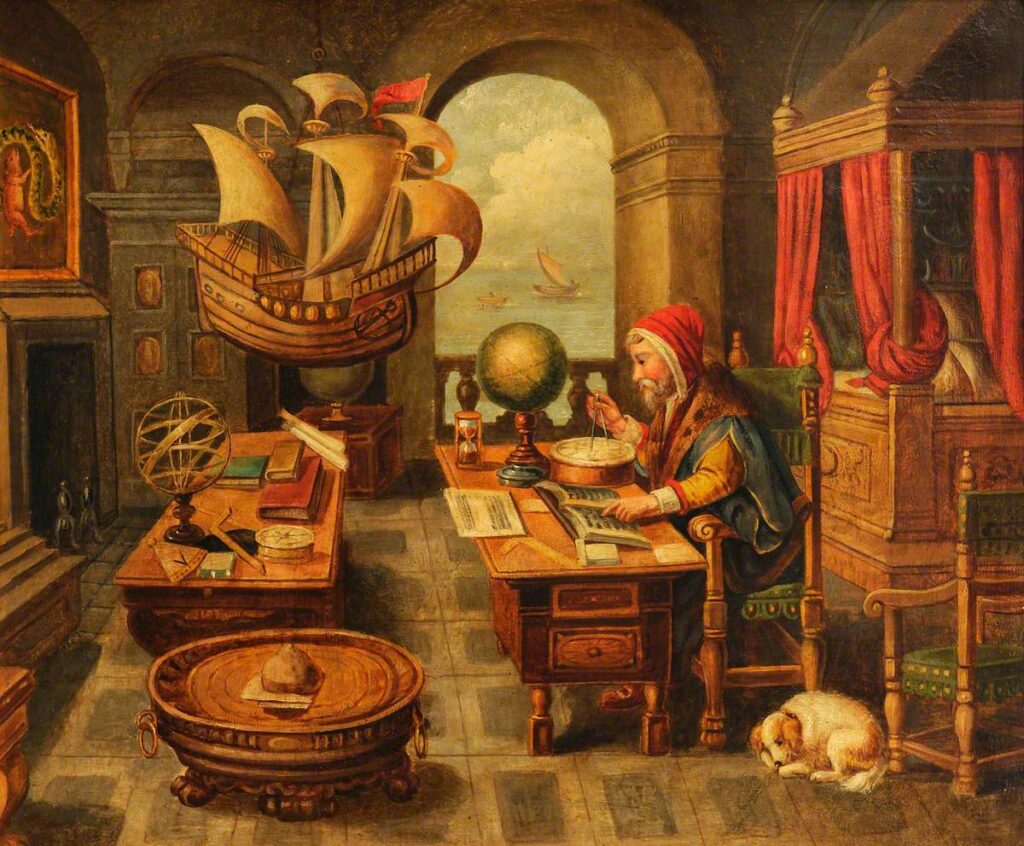
Lapis Polaris, Magnes (The Lodestone & Magnetic Compass), engraved by Philips Galle after Jan van der Straet (Stradanus) for the Nova Reperta series (Antwerp, c. 1590). A cosmographer works at his table with a magnetic compass, lodestone, dividers, and a brass astrolabe beneath a suspended ship’s model, while ocean-going caravels and carracks sail across the horizon.
Italian Cards
German Cards
While the complex planispheric astrolabe and the universal Saphea remained the domain of astronomers and royal cosmographers, practical travelers, pilots, and sea captains relied on a rugged trio of instruments to survive the open ocean:
Above: hand-drawn and hand-painted Mamluk Playing Cards, XV or early XVI century. The original pack of cards is in the Topkapu Museum in Istanbul and measures 252 x 95 mms, which makes them rather large to hold in one’s hand. The pack of cards in the Topkapu Museum is incomplete and consists of 47 cards, divided into 4 suits, with 14 cards per suit, so that the complete pack would have contained 56 cards. The cards illustrated here are from a reconstructed
facsimile edition published by Aurelia Books, Brussels and Louvain, 1972. The boxed set also contains a booklet produced by Jan Bauwens which contains the Arabic inscriptions on the cards translated by Prof. Tangi of the University of Istanbul.
Add text here.
The Early Italian Playing Cards
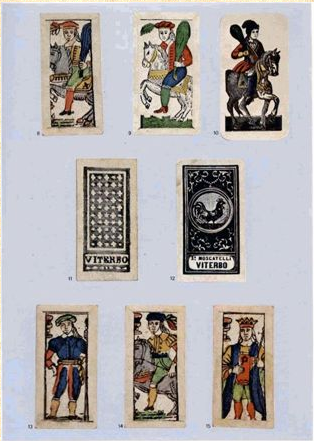
Romagnole (?) pattern, 40-card deck by ROMA (?), 18th/19th century
Specific pattern: Carte Viterbesi (?) – hibride between Piacentine and Romagnole
Estinte e diffuse soprattutto in Italia meridionale, erano un ibrido tra le piacentine e le romagnole, con le quali spesso venivano confuse; queste carte misuravano 45mm per 90mm. La similitudine con le piacentine era evidente soprattutto per l’asso di denari raffigurante un’aquila, mentre quella con le romagnole era evidente per via dei cavalli rampanti e i cavalieri senza staffe. Come la maggior parte delle carte italiane in stile spagnolo, queste avevano bastoni e spade disposte in modo simmetrico, fatta eccezione per il tre di bastoni. Comunque, il mazzo, composto da 40 carte, era riconoscibile per via di un grappolo d’uva rappresentato sul quattro di denari (a volte sostituito da una lupa coi gemelli, simbolo di Roma*) e un leone rappresentato sul quattro di coppe. I re di denari e coppe avevano in mano scettri al posto delle tradizionali asce, l’asso di coppe aveva una base tonda anziché esagonale, le spade erano lamellate anziché dritte e i colori dei bastoni non erano tre (come nelle carte romagnole), ma due.
* The Capitoline Wolf (Lupa Capitolina): wolf suckling twins Romolus and Remos, symbol for Rome.
- “Spanish style” South Italian cards (Naples and Sicily belonged to Aragon)
- Single sided woodcut, stencil colored
- Size: 9.0 cm x 4.8 cm
- Rim: folded over from printed backside
- Backside: carpet pattern printed in black, stars enclosed in linked elements
- Backside legend: “ROMA” in panel on bottom
Trademark card: Copa 4
- Legend: “ROMA / DEPOSITO / VIA DE’BAULLARI / Num.° 1.”
- Possible remains of tax stamp on bottom
Vignette card: Oros 4
- Legend: none
- Image: Romolus and Remos suckling wolf
Deck composition
- Coppe/copas (cups): ace / 2 / – / 4 / 5 / 6 / 7 / knave / horse / king (9 out of 10 cards)
- Denari/oros (coins): – / 2 / 3 / 4 / 5 / 6 / 7 / knave / – / king (8 out of 10 cards)
- Spade/espadas (swords): ace / 2 / 3 / 4 / 5 / 6 / 7 / knave / – / – (8 out of 10 cards)
- Bastoni/bastos (cudgels): ace / 2 / – / 4 / 5 / 6 / 7 / knave / horse / king (9 out of 10 cards)
- Extant are: 34 of the complete deck of 40 cards (lost are 6 cards)
- Missing are: C-3 / D-ace / D-knight / S-horse / S-king / B-3
Compare:
http://www.tarot-as-tarocchi.com/le_carte_viterbesi_vissero_soltanto_100_anni.html
Name of town (here “VITERBO”) in panel on bottom of backside
(similar to “ROMA” on our cards)
Folded-over edges
Alternate framed star pattern on rear
Roma cards
Read Next: Chess →